Showing posts with label Colourful semantics. Show all posts

Friday, 13 September 2019

Using Visual supports for writing

Last Friday we held a workshop here at Sommerville and invited SENCO's teacher's and teacher aides to participate.  My colleague Donna and I presented on teaching reading and writing to Children with Special Educational needs. This was well received by all who attended.

As part of my presentation I reiterated to importance of using visuals with our students.  I also demonstrated  how to use Colourful Semantics and showed the progress students have made using this programme. In my previous blog posts, I shared more information on Colourful Semantics, so please have a look.

In this post, I would like to share a WOW moment we had with one of my students who would not engage in writing. We have been using 'Who, doing what , where". Here are some visuals that we used.


This student , who has very complex needs, was not engaging is any form of writing, but after many attempts at using 'Draw and talk', as explained in my previous blogs and engaging the student with real experiences, the students attempted to write ' I want to go to the beach hotel". This was a huge moment for the student and celebrated by all.

He had gone on holiday and we used the 'real life experience' to encourage him to write about his holiday. He was not motivated to write independently, so we used the photos from his holiday and asked him what was happening in each photo. We also used , 'Who, doing what" This is what he said. I added it to clicker sentences and the student was able to put the sentence in the correct order. He felt really proud of his work and wanted to share it with his teachers and family.


Friday, 28 June 2019

Students using Colourful Semantics

Testing my hypotheses using Colourful Semantics.

I have continued to use Colourful Semantics with a few of my students.
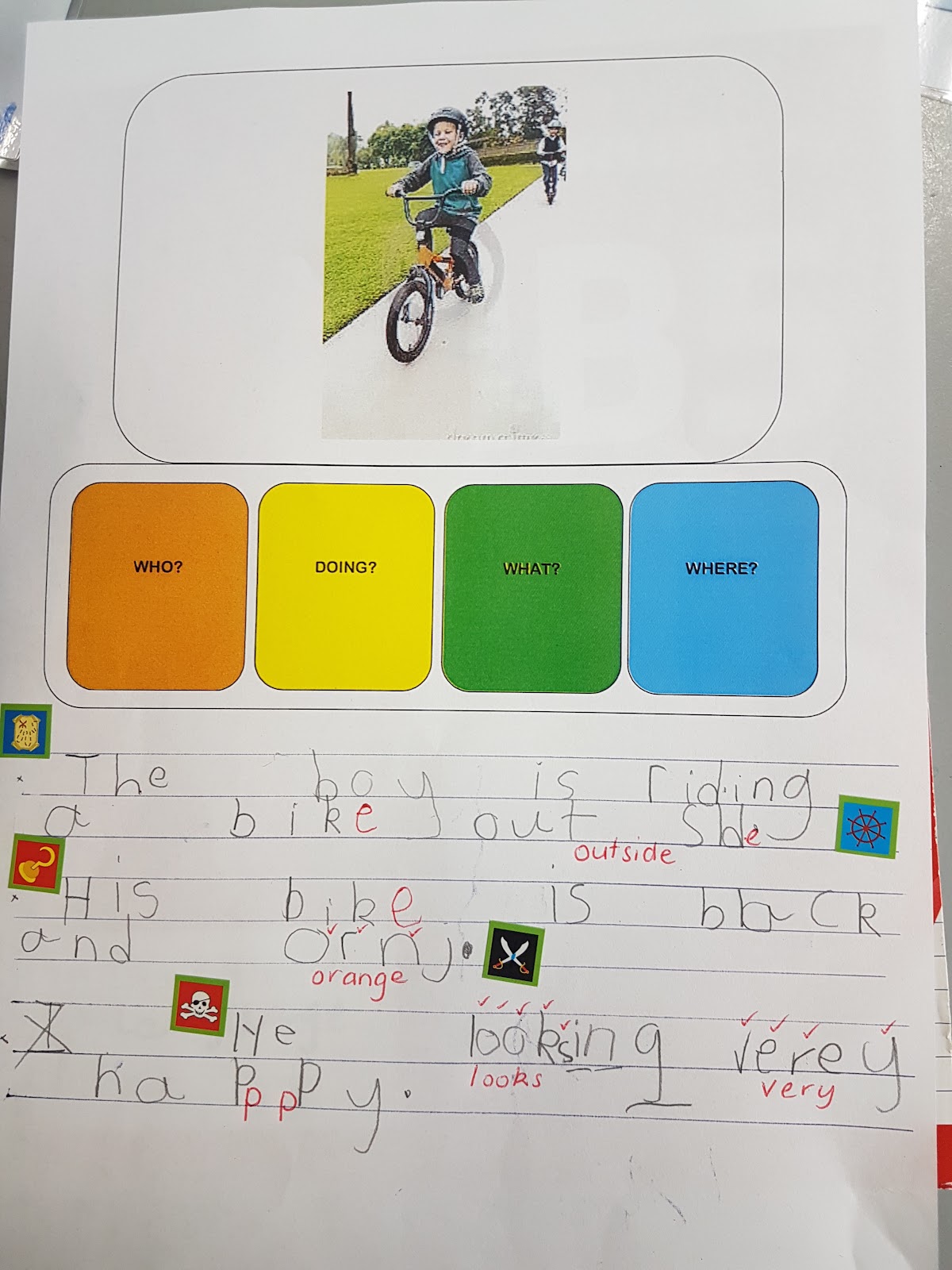
The picture is a motivator. Also using the ‘Who, doing, what , where” visual
helps the student structure their sentences better.
This student was able to add more details to his writing. He said 'I like this writing".
He will recites the 'Who , doing, what ' out loud as he writes.


This student is using nouns and verbs, but is still missing the little words.
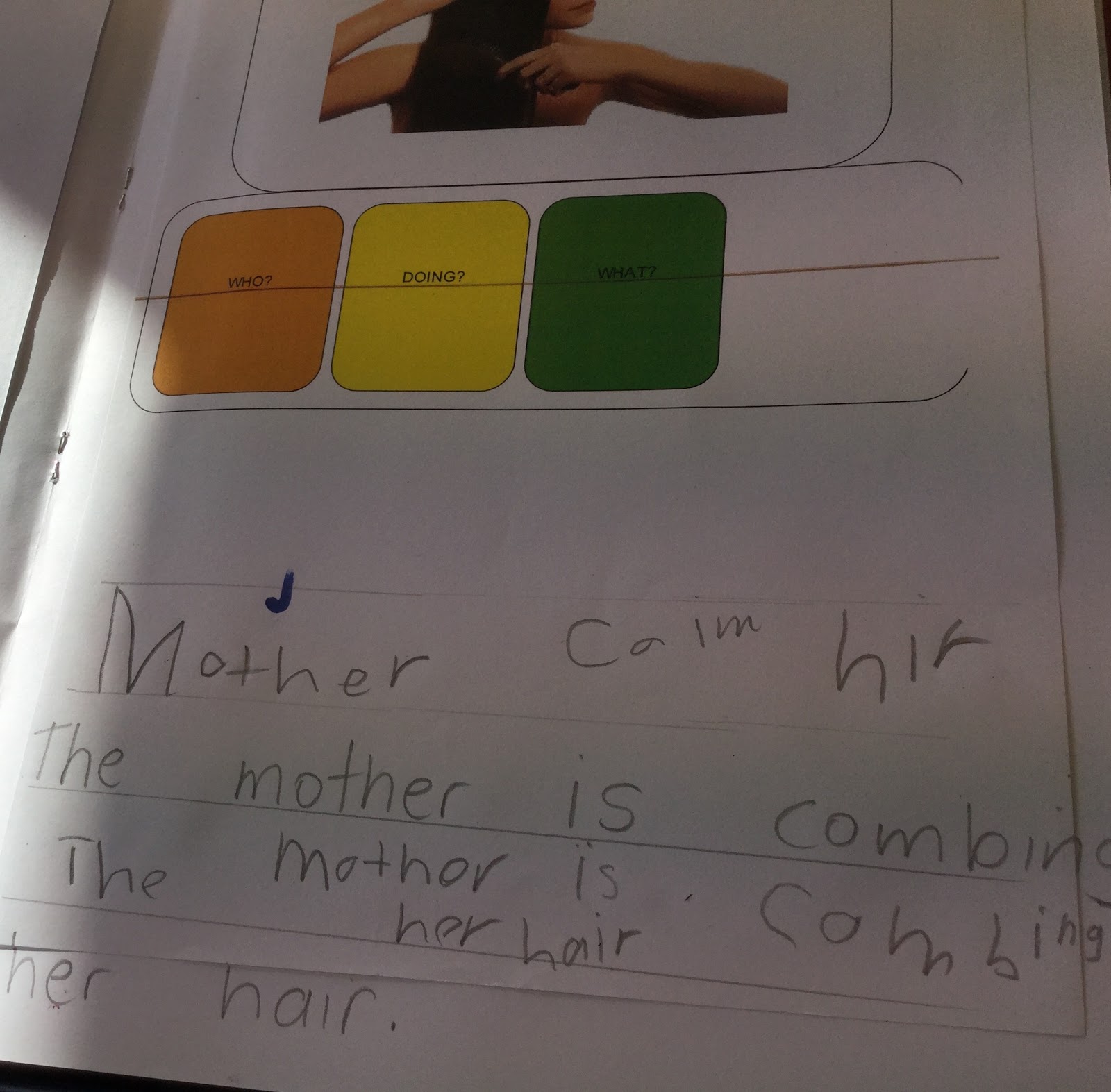
The sentence is then modeled to her by the teacher and she is able to copy.
She was more motivated and wrote her sentence immediately.


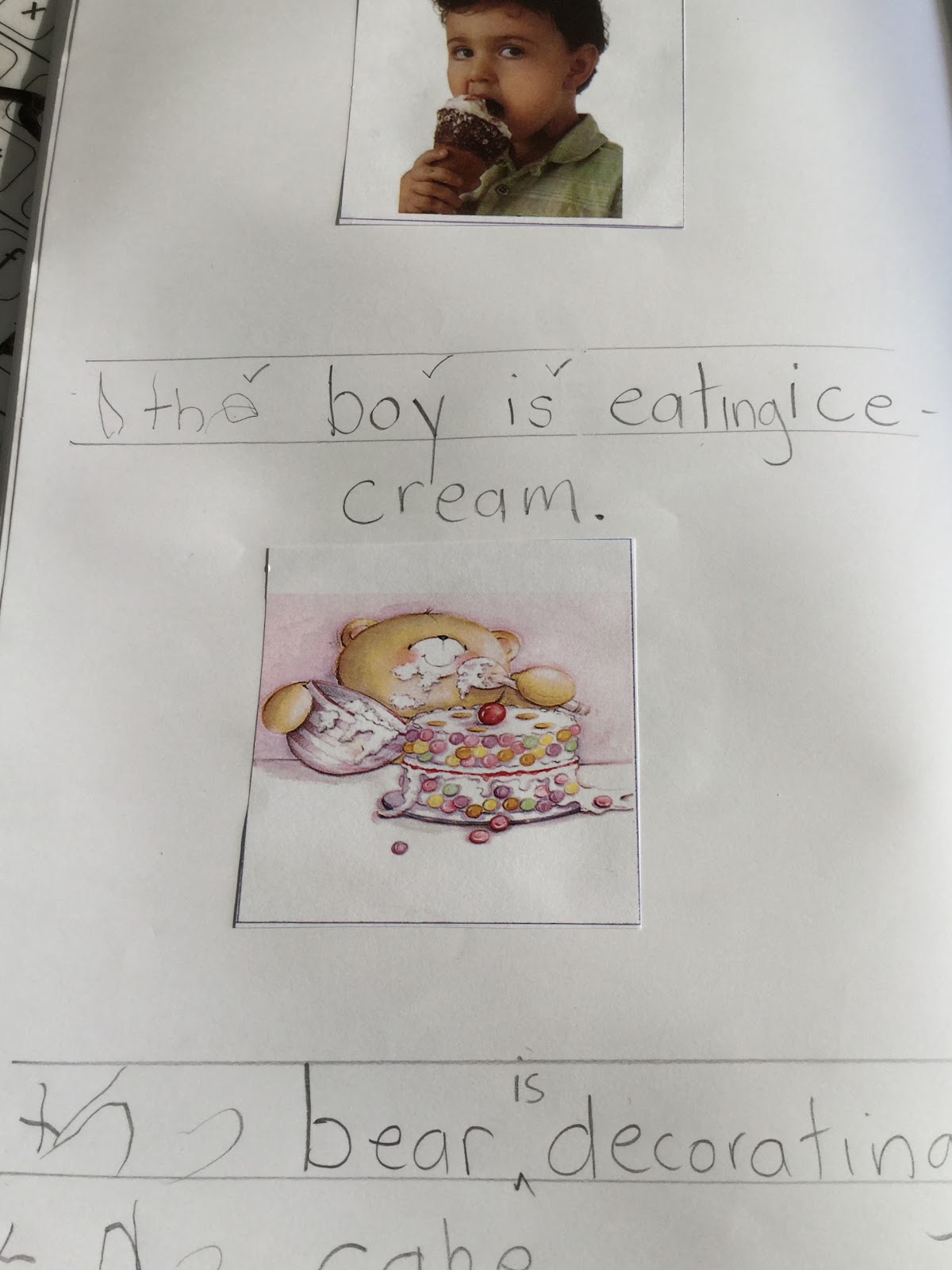
This example is of a student who is only beginning to write.
He knows what he wants to say and tells his sentence to the teacher, he attempts the ‘THE’.
There is no pressure for him to write, we are looking for ideas. He enjoys having the Pictures as visual
supports and he is also following, ‘who, doing what.’

Monday, 3 June 2019

Colourful Semantics


What is Colourful Semantics?


Hypotheses - 3  

If I use the Colourful Semantics program to motivate students, will this then help them to form a sentence independently.

My students struggled to understand the parts of a sentence. I began teaching what WHODOING WHAT , WHERE means using The Colourful Semantics programme. We worked on many examples.
I began to use this program when one of my emergent students was really struggling to construct a simple sentence. He wasn’t able to recall events from the weekend, had no idea of subject and verb. This program uses visual supports which helped the student. I spent a few weeks teaching what WHO, DOING WHAT MEANS. 

Colourful semantics is an approach created by Alison Bryan. It is aimed at helping children to develop their grammar but it is rooted in the meaning of words (semantics).
Colourful semantics reassembles sentences by cutting them up into their thematic roles and then colour codes them.
The approach has 4 key colour coded stages. There are further stages for adverbs, adjectives, conjunctions and negatives.
1.     WHO – Orange
2.     WHAT DOING – Yellow
3.     WHAT – Green
4.     WHERE – Blue
The approach helps children to organise their sentences into key levels. The approach is used in stages and helps children develop language and vocabulary in addition to grammatical structure. It can be used to help children who are starting to develop language and have limited vocabulary to confident talkers who struggle to organise the grammatical content of their sentences.
Who can use Colourful Semantics?
The approach can be used with children with a range of Speech, Language and Communication Needs including:
·       Specific Language Impairment
·       Developmental Delay or Disorder
·       Autistic Spectrum Condition
·       Down Syndrome
·       Literacy difficulties
Why use Colourful Semantics?
There are a range of benefits to using this approach, including but not limited to;
·       Encouraging wider vocabulary
·       Making sentences longer
·       Helps children to answer questions or generate responses to questions
·       Developing use of nouns, verbs, prepositions and adjectives
·       Improves story telling skills
·       Can be transferred to written sentences and written language comprehension
·       Can be carried out individually or in small groups


After explicitly teaching my student to use this program, the next few examples are of students at different levels

This is one of my student's work sample using Colourful semantics, just with visuals


In this example, the student isn't writing independently, so  I wrote what the student said and modeled what needed to be done. 


This student is writing with support. Using colorful semantics to help her construct her sentence,this is what she wrote. 

All three examples show students using Colourful Semantics, but at their individual level.
Will this work for my other students?