Showing posts with label writing tools. Show all posts

Friday, 16 August 2019

Draw and talk

Draw and Talk

Uses drawing to ‘Sketching’ enhances the meaning as children draw.
Drawing is a complex sensory motor action requiring the selection, organisation and communication of visual material.
Drawing establishes a relationship between the child and the world.
‘My drawing is about______, because______’


This student has Down Syndrome and significant language delays. He is at the drawing stage, sometimes he attempts to write individual letters. Currently he is not motivated to use a device. 
He has some amazing ideas and even though his language is very delayed, he uses a combination of NZ sign language  and speech to convey his message. in the pictures below, the class was asked to create an invention. He decided to invent a self cleaning food bowl for his cat. He wanted to call it 'Doolalee machine'. He did all the designing and I recorded what he said. Due to the complexities of writing, this student wouldn't attempt it. He has the ideas.....by using draw and talk, the adult is able to record what he say.
Thereafter he made his invention. He often requires lots of motivation to get started with his writing, but because this was of interest, he got started immediately with the drawing. I wrote what he said. he was able to then make the invention. He was so excited to show everyone what he drew and made.


Friday, 2 August 2019

Evidence Sharing

Students writing sample.

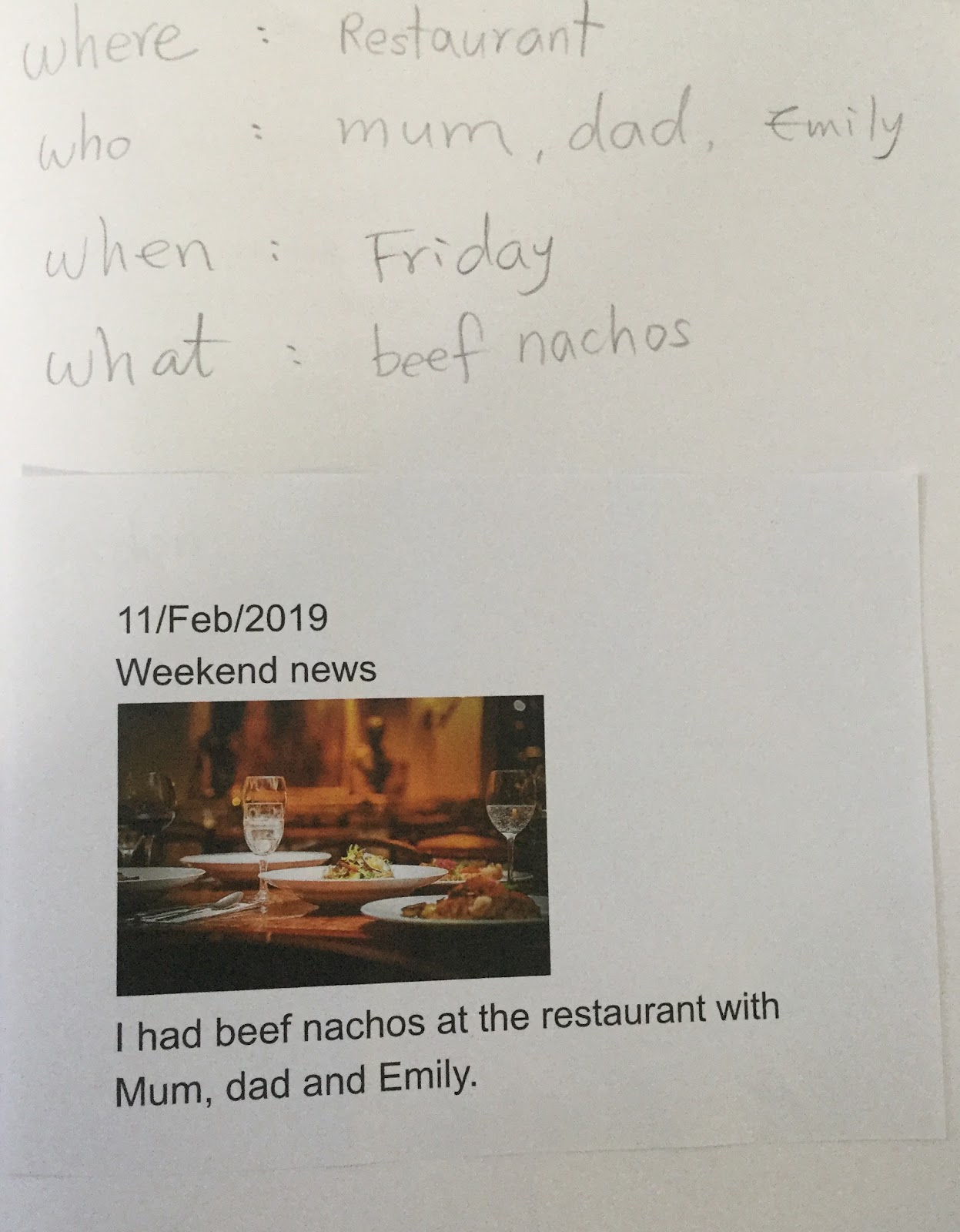
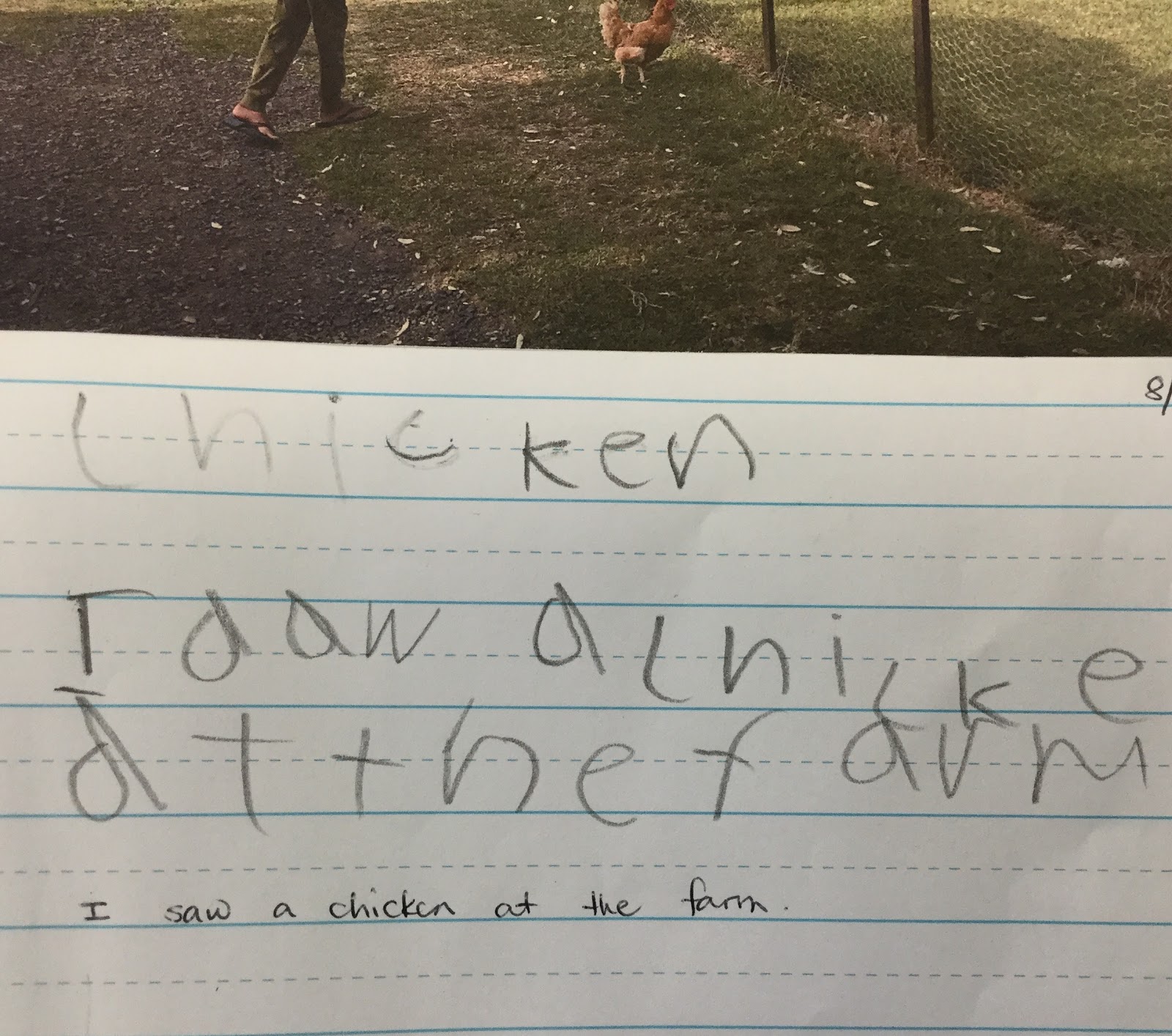
In my previous blogs post , I began testing my hypothesis around writing for authentic/real reasons. I found that some students were more motivated to write and stayed on task for longer periods if they had an experience to write about. They could relate to their experience. I got the whanau involved and they are sharing photos. As student are not always able to give the details of what took place, whanau are providing the details. 


This student is usually not motivated to write. She will take a long time before getting started and would need lots of motivation. 
She went to Fiji for the school holidays. she really enjoyed the trip with her family and was very exited to write about it. Even though her sentences are not grammatically correct, I am able to get the gist of what took place. I have then modeled the sentence back to her.
Even though we have done explicit teaching using Who, doing what, this student still has difficulties in constructing a sentence. 
She is very excited to share her story with her class mates and whanau and wants to use this for her speech as well. 


Friday, 5 July 2019

Investigating writing tools

Using clicker sentences as 'A' writing tool 

“Students can start exploring and experimenting with alternate pencils/ writing tools 
BEFORE they know letter names or sounds,and well before they have control of 
the choice making required to choose specific letters.
Over time, you begin to see evidence that students are learning letters.”
–The Center for Literacy and Disability Studies

What is an alternative pencil/writing tool?
In order to develop literacy skills, all students need a way to write using the full alphabet no
 matter what level of understanding they appear to have about print.
(In my previous blog posts, I discussed a range of alternative writing tools).
Developed by Hanser (2009) at the Centre for Literacy and Disability Studies (CLDS), 
an alternative pencil is defined as anything that provides a student with access to all 
26 letters of the alphabet.

How can students benefit from using an alternative pencil/writing tool?

Writing is an essential component of literacy instruction for students without disabilities and a part of their daily instruction. In order for students with significant disabilities to develop as readers and writers, daily writing is equally, if not, more important. However, this becomes a challenge when most students with significant disabilities are unable to hold a pencil.

Which students would benefit from using an alternative pencil/writing tool?

For students with physical, cognitive or linguistic challenges, an alternative pencil can offer a way to write and/or explore the alphabet while focusing the majority of their cognitive energy on text production.
Alternative “pencils” /writing tools were created for students unable to hold a traditional pencil or physically manipulate a standard keyboard. As well, if a student can hold a pen or a pencil but struggles to form letters with it, especially if they have already been practicing for years, then we need to look at an alternative pencil for the majority of their writing.
Alternative pencils can be used with writers of varying abilities and ages including students who are emerging writers and those who are able to write more conventionally (Browder & Spooner, 2011).

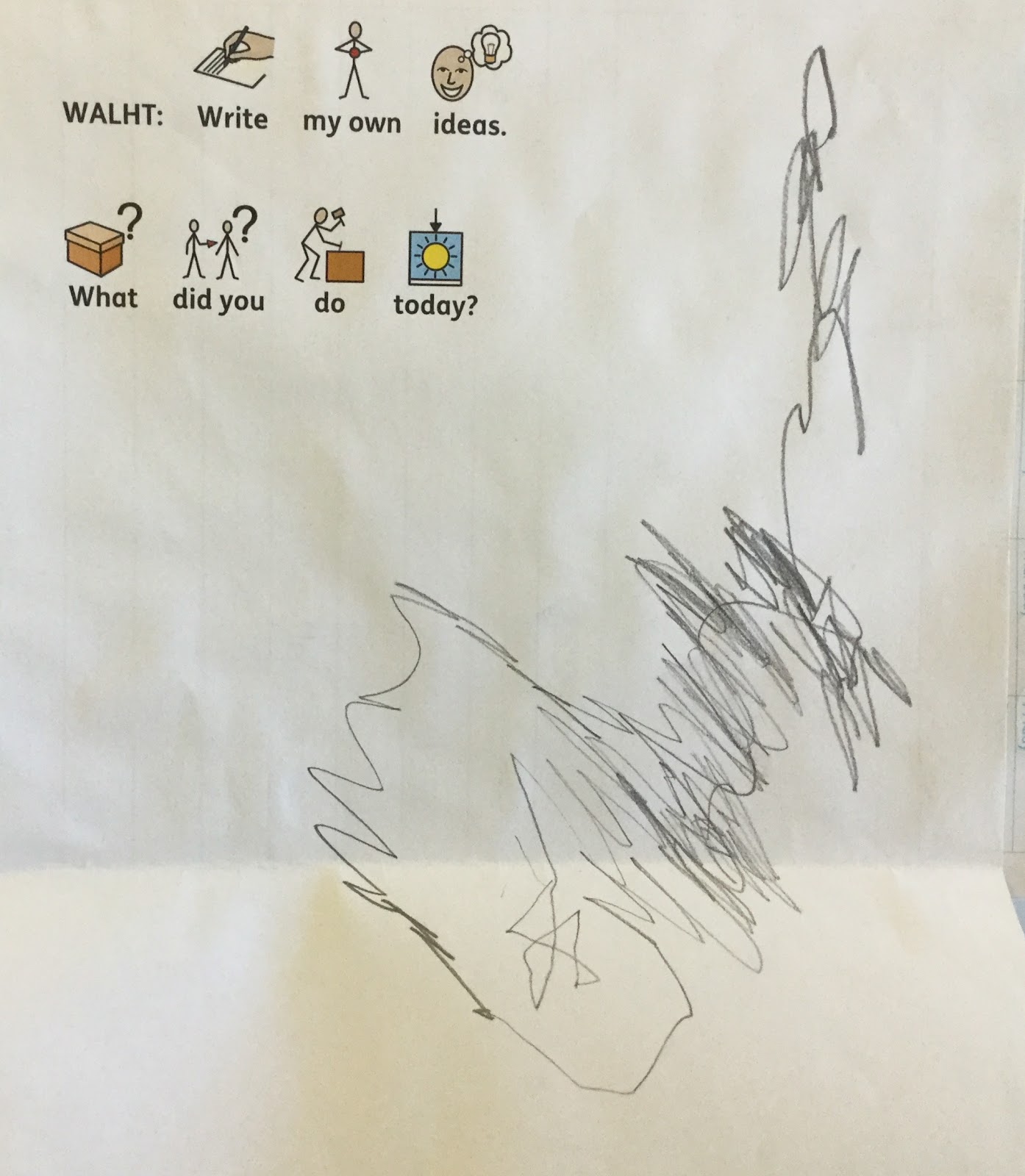
This student is unable to form any letters independently and is at the scribbling stage.
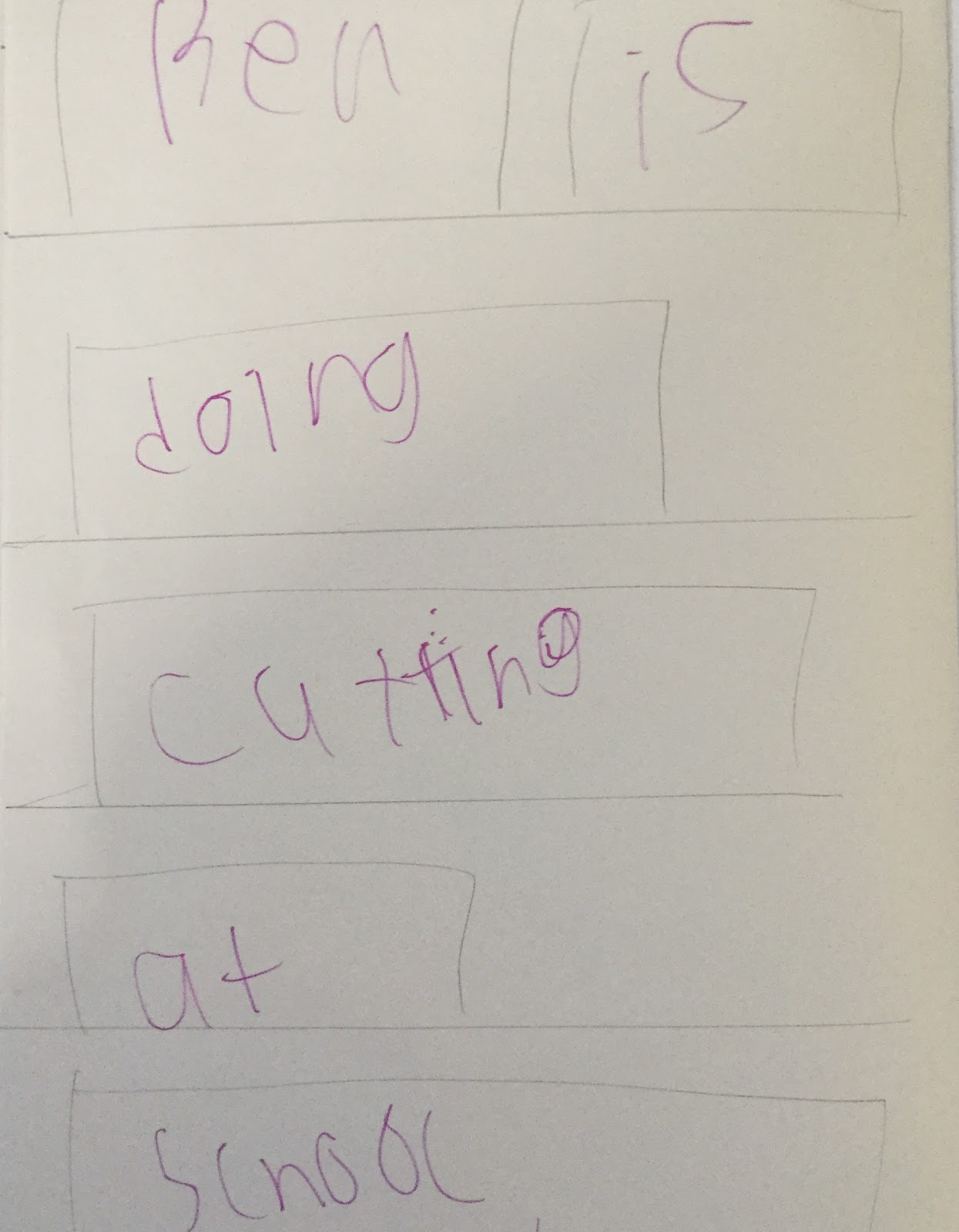
Even though his language is limited, when something of interest happens, he does have ideas and attempts to say what is happening. Here I introduced him to clicker sentences. The student gave the sentence. I added the words and he was able to put that in a sentence. He was really exited when it read back to him. This was definitely a good motivator.


This student is able to string a few words together, she is very keen on adding her thoughts and wants to attempt spelling the words, she is still learning to use the predictive text. This is her independent work.


This student has had a few opportunities to work on clicker sentences and is able to form a simple sentence. He is very motivated to use this as his writing tool as he is successful and feels a sense of accomplishment. This student has autism and will only write for real reasons. He has to experience something to write about it. 

Wednesday, 10 April 2019

What writing looks like at some Sommerville classes.


Emergent Writing

At Sommerville most students are emergent writers
Children explore and experiment with writing. In the process, they develop understandings about the functions and form of print. These understandings become increasingly sophisticated. Hanser (2006)
Writing is about ...
•  Sharing ideas and communicating with others.
•  Writing for real reasons.
•  Thinking and actively constructing print.
•  Exploring the alphabet.
   Making independent attempts.

At Sommerville, we believe that every child needs a writing tool                                                     

 A writing tool includes:
  • – Pencils / Pens
  • – Flip charts
  • – Alphabet boards
  • – Eye gaze
  • – Keyboards with talking word processors
  • – Alternate keyboards
  • – Simplified keyboards
  • – Onscreen keyboards
  • – iPads and apps
  • – Speech generating devices
  • - Predictive text software

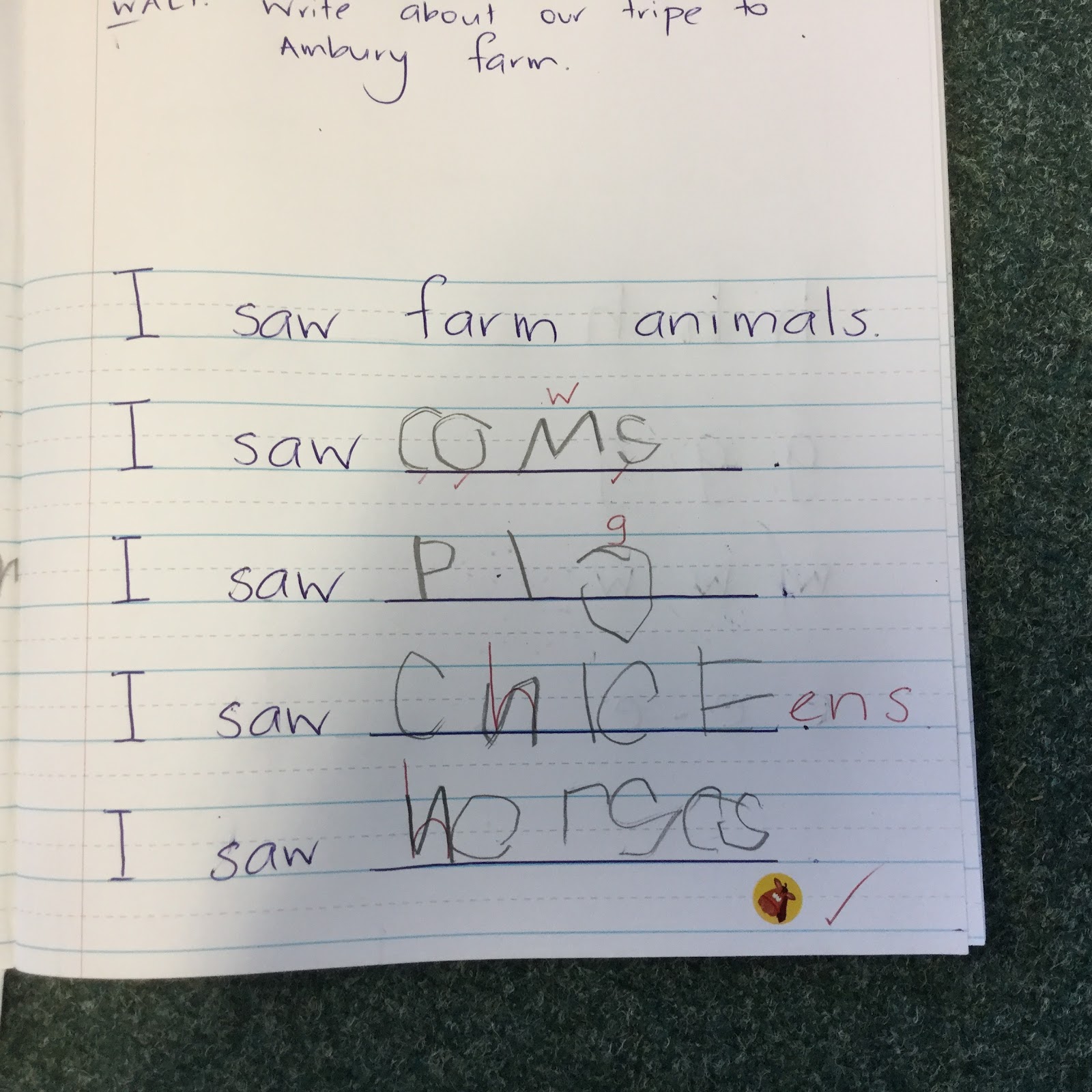
Here are some examples of students writing