Friday, 16 August 2019

Draw and talk

Draw and Talk

Uses drawing to ‘Sketching’ enhances the meaning as children draw.
Drawing is a complex sensory motor action requiring the selection, organisation and communication of visual material.
Drawing establishes a relationship between the child and the world.
‘My drawing is about______, because______’


This student has Down Syndrome and significant language delays. He is at the drawing stage, sometimes he attempts to write individual letters. Currently he is not motivated to use a device. 
He has some amazing ideas and even though his language is very delayed, he uses a combination of NZ sign language  and speech to convey his message. in the pictures below, the class was asked to create an invention. He decided to invent a self cleaning food bowl for his cat. He wanted to call it 'Doolalee machine'. He did all the designing and I recorded what he said. Due to the complexities of writing, this student wouldn't attempt it. He has the ideas.....by using draw and talk, the adult is able to record what he say.
Thereafter he made his invention. He often requires lots of motivation to get started with his writing, but because this was of interest, he got started immediately with the drawing. I wrote what he said. he was able to then make the invention. He was so excited to show everyone what he drew and made.


Friday, 9 August 2019

Real reasons for writing

Student's work

This student is also more motivated to write when he has had an experience. He needs to know why he is writing, in this case it is to share his holiday experience. 
During the holidays he visited the sky tower. Using visual supports this is what he wrote.

After explicit teaching of sentence construction, he is able to form a simple sentence. He is also adding more information to his writing.
More importantly, he is wants to share his writing with others at school and his whanau.
Beginning a task and staying focused is an ongoing issue. He requires lots of support and motivation to get started. He has a reward system in place to help him stay focused. 


Even though he responds well to this system most times, we had a few incidents regarding this students behavior. He finds it difficult to manage himself. We have used a range of social scripts to help him make good choices. Recently he hurt another student, We used this opportunity to write a letter to the people involved also showing him real reasons for writing.


Friday, 2 August 2019

Evidence Sharing

Students writing sample.

In my previous blogs post , I began testing my hypothesis around writing for authentic/real reasons. I found that some students were more motivated to write and stayed on task for longer periods if they had an experience to write about. They could relate to their experience. I got the whanau involved and they are sharing photos. As student are not always able to give the details of what took place, whanau are providing the details. 


This student is usually not motivated to write. She will take a long time before getting started and would need lots of motivation. 
She went to Fiji for the school holidays. she really enjoyed the trip with her family and was very exited to write about it. Even though her sentences are not grammatically correct, I am able to get the gist of what took place. I have then modeled the sentence back to her.
Even though we have done explicit teaching using Who, doing what, this student still has difficulties in constructing a sentence. 
She is very excited to share her story with her class mates and whanau and wants to use this for her speech as well. 


Friday, 26 July 2019

Monitoring change


Achievement Challenge 5
Theory of action/ chain of events
Implementation of change
Monitoring the effects
Improve the achievement of students with additional needs in the learning areas of English/key competency using language symbols and texts
If students are able to manage themselves, will this help them improve their writing outcomes?
The areas of focus has been:
Will students be motivated to write and manage themselves if

They are asked to write for real/authentic reasons and if

They have the correct writing tool.
After looking at the research by Dr Sally Clendon, I encouraged whanau to be involved. Each week they sent in a range of photos from the weekend. These are the events that the student can relate to, they have had the experience and are more eager to share some information. 
It is authentic and students are more motivated. 
Photos are also used from daily school activities.

I also used the research that Jane farrall did on finding the correct writing tool. I investigated  a range of alternative writing tools and trialled it with students.
Once they had a tool that they were successful using, students were more motivated to write. 

Daily opportunities to write and explicit teaching had to occur.
I have noticed improved attitudes in students.

Students have a better understanding of what writing means.

They are more motivated to write.

Students are working on a task for longer periods and not giving up.

They are wanting to share their work both at school and at home.

They feel more confident in attempting writing.

The evidence is in the writing sample.

Tuesday, 23 July 2019

Inclusive Education


Inclusive teaching and learning

On Thursday and Friday last week my colleague Donna and I attended the Inclusive Education symposium at Kohia. We took away a few gems from the day and I would like to share some of that learning.

Vonnie Jones from MoE shared  information about the Inclusive education website and here are some of her key messages.

  • Our schools and classrooms are places where we have rich diversity and sometimes complex challenges.
  • Teachers don't always feel confident they have the skills and knowledge to respond to the unique strengths and needs of all learners in their classrooms.
  • Sometimes teachers worry that in order to meet all the learning and well-being needs of learners they will need to plan many separate programmes. 
  • The Inclusive education website has information and strategies that will help teachers plan for and meet the needs of all learners and what works for some, can work for all.
Here is the link to the website- https://www.inclusive.tki.org.nz/

Friday, 5 July 2019

Investigating writing tools

Using clicker sentences as 'A' writing tool 

“Students can start exploring and experimenting with alternate pencils/ writing tools 
BEFORE they know letter names or sounds,and well before they have control of 
the choice making required to choose specific letters.
Over time, you begin to see evidence that students are learning letters.”
The Center for Literacy and Disability Studies

What is an alternative pencil/writing tool?
In order to develop literacy skills, all students need a way to write using the full alphabet no
 matter what level of understanding they appear to have about print.
(In my previous blog posts, I discussed a range of alternative writing tools).
Developed by Hanser (2009) at the Centre for Literacy and Disability Studies (CLDS), 
an alternative pencil is defined as anything that provides a student with access to all 
26 letters of the alphabet.

How can students benefit from using an alternative pencil/writing tool?

Writing is an essential component of literacy instruction for students without disabilities and a part of their daily instruction. In order for students with significant disabilities to develop as readers and writers, daily writing is equally, if not, more important. However, this becomes a challenge when most students with significant disabilities are unable to hold a pencil.

Which students would benefit from using an alternative pencil/writing tool?

For students with physical, cognitive or linguistic challenges, an alternative pencil can offer a way to write and/or explore the alphabet while focusing the majority of their cognitive energy on text production.
Alternative “pencils” /writing tools were created for students unable to hold a traditional pencil or physically manipulate a standard keyboard. As well, if a student can hold a pen or a pencil but struggles to form letters with it, especially if they have already been practicing for years, then we need to look at an alternative pencil for the majority of their writing.
Alternative pencils can be used with writers of varying abilities and ages including students who are emerging writers and those who are able to write more conventionally (Browder & Spooner, 2011).

This student is unable to form any letters independently and is at the scribbling stage.
Even though his language is limited, when something of interest happens, he does have ideas and attempts to say what is happening. Here I introduced him to clicker sentences. The student gave the sentence. I added the words and he was able to put that in a sentence. He was really exited when it read back to him. This was definitely a good motivator.


This student is able to string a few words together, she is very keen on adding her thoughts and wants to attempt spelling the words, she is still learning to use the predictive text. This is her independent work.


This student has had a few opportunities to work on clicker sentences and is able to form a simple sentence. He is very motivated to use this as his writing tool as he is successful and feels a sense of accomplishment. This student has autism and will only write for real reasons. He has to experience something to write about it. 

Friday, 28 June 2019

Students using Colourful Semantics

Testing my hypotheses using Colourful Semantics.

I have continued to use Colourful Semantics with a few of my students.
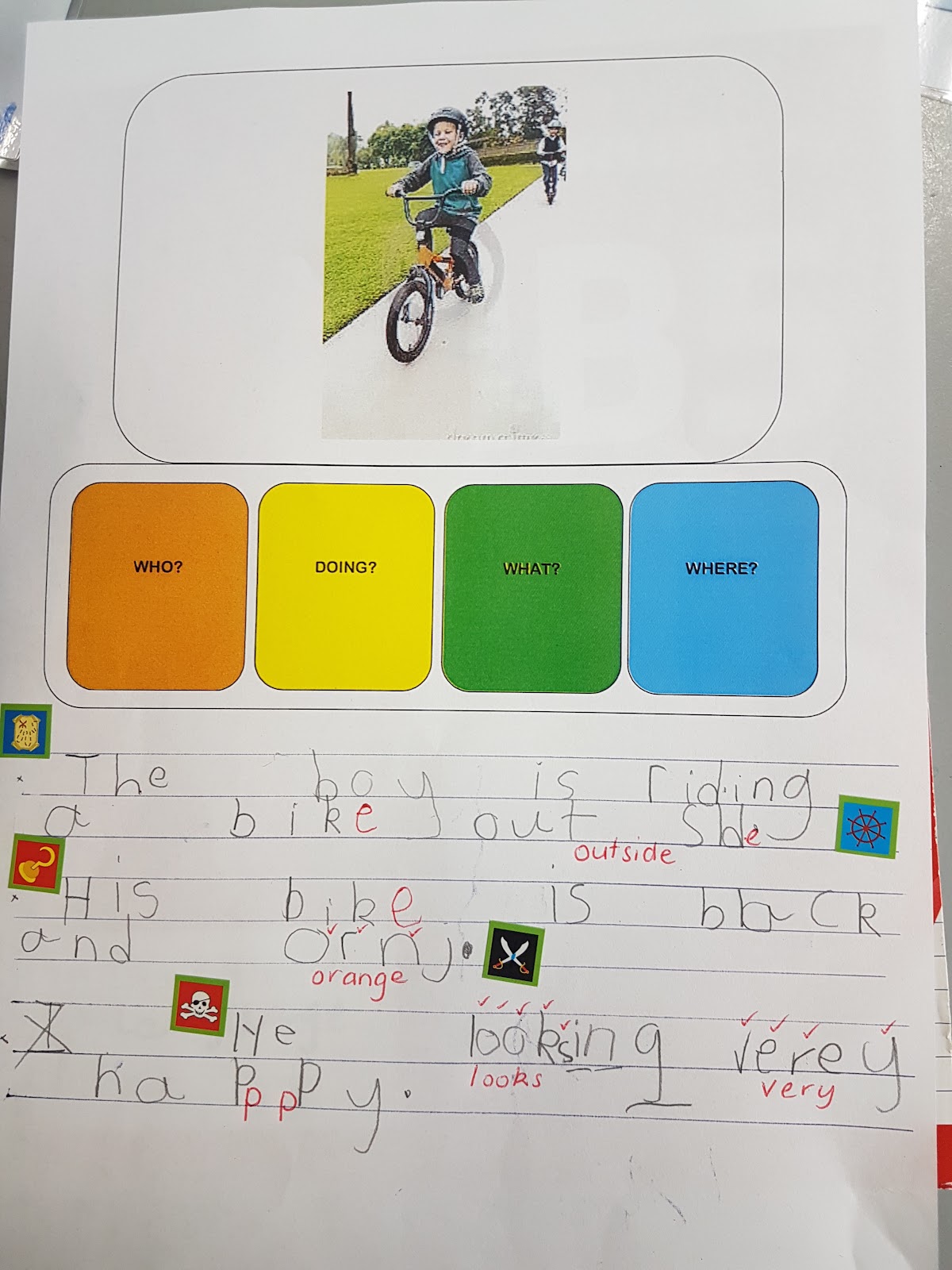
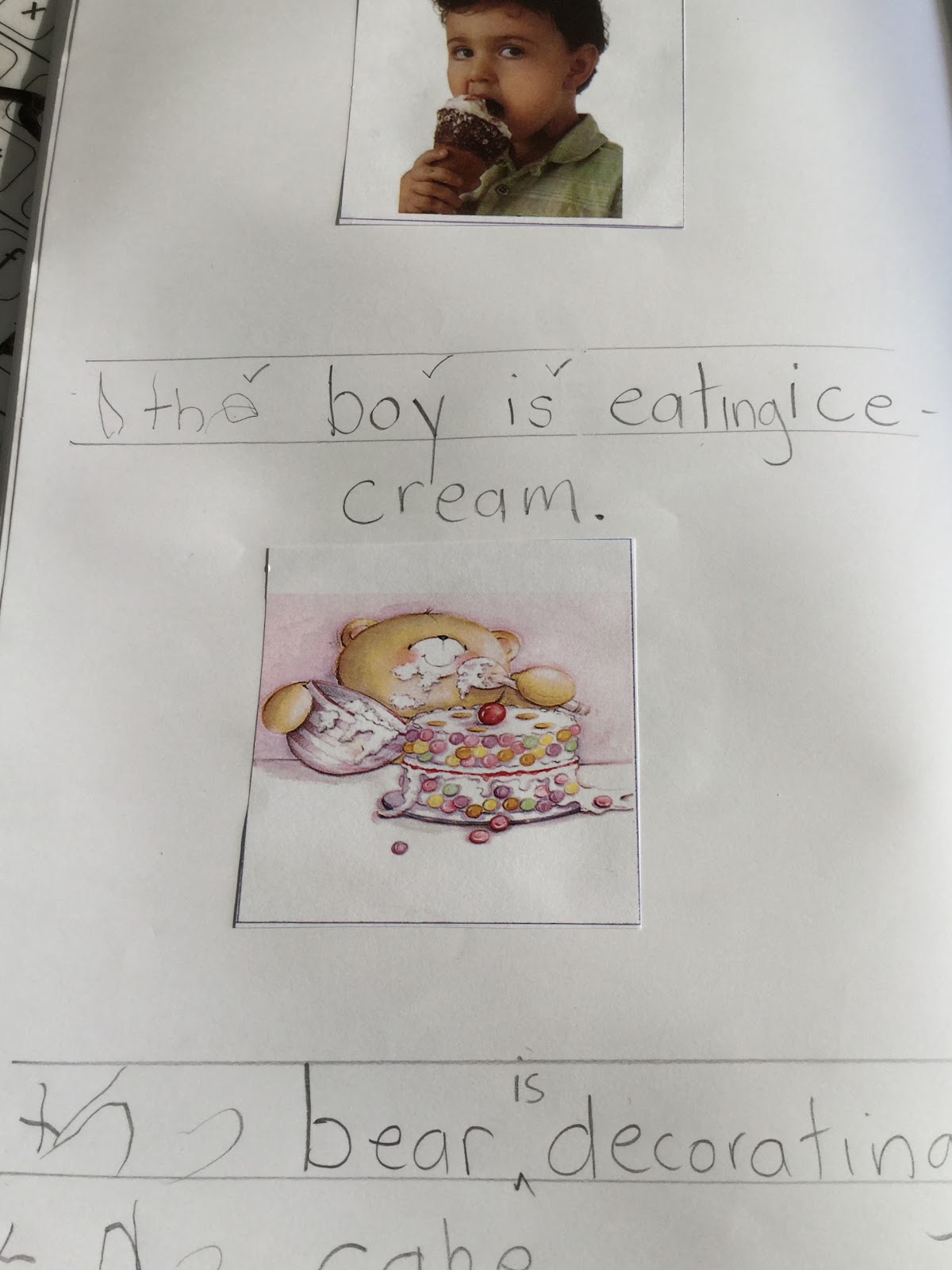
The picture is a motivator. Also using the ‘Who, doing, what , where” visual
helps the student structure their sentences better.
This student was able to add more details to his writing. He said 'I like this writing".
He will recites the 'Who , doing, what ' out loud as he writes.


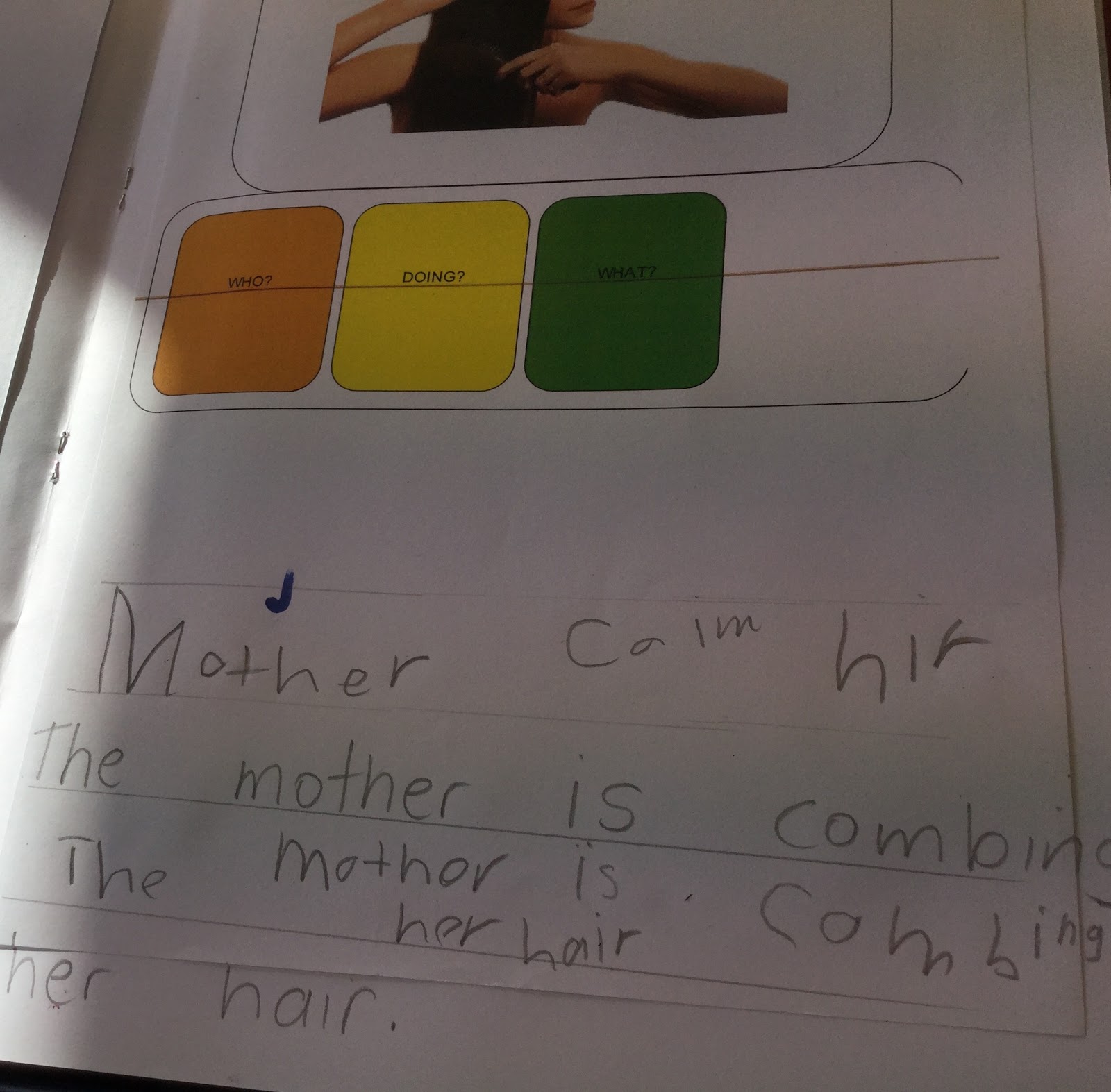
This student is using nouns and verbs, but is still missing the little words.
The sentence is then modeled to her by the teacher and she is able to copy.
She was more motivated and wrote her sentence immediately.


This example is of a student who is only beginning to write.
He knows what he wants to say and tells his sentence to the teacher, he attempts the ‘THE’.
There is no pressure for him to write, we are looking for ideas. He enjoys having the Pictures as visual
supports and he is also following, ‘who, doing what.’

Tuesday, 11 June 2019

Questions we can ask about writing

As teachers , here are some questions we can ask about the way we teach writing.

Writing is a complex task, involving ideas, language, words, spelling and transcribing or selecting letters. We need to teach all of these skills – and eventually students need to be able to do all of these, within the one task, to become writers.

Overall guidelines
  • Do you have time scheduled for an independent writing block every day?
  • Are your students using a pencil or alternative writing tool that allows them to focus on the cognitive aspects of writing e.g. alphabet board, flip chart, keyboard, eye gaze system, iPad and app, computer, pen or pencil?
  • Does their writing tool include access to all 26 letters of the alphabet?
  • Do your students have real reasons for writing? (and remember – writing never involves copying and tracing; writing involves thinking of ideas, language, words AND transcribing)
  • Do you model writing to your classroom each time before you ask them to write?
  • Do you have a time for writer’s chair so that students can share their writing with others?
  • For emergent students
  • Are you giving your students lot of opportunities to learn the function of writing without focusing on the form e.g. following through on notes handed to you, writing yourself reminders and then using them, writing a morning message?
  • Do they have daily opportunities to write without standards using a writing tool with access to all 26 letters?
  • When they have finished writing do you say “now let me show you how I would write it” and model writing rather than interrupting them during the writing task or putting demands on their writing?
  • Are you offering them a range of writing tasks, such as writing about personal experiences, high interest topics, classroom topics, letter writing, signing in?
  • Are you following through on writing tasks e.g. posting letters?
  • Do you have a daily or weekly shared writing activity, such as predictable chart writing?

Writing (with an alphabet chart, teacher scribes)


💚Student signing in→


For conventional students

  • Do you focus your modelling of writing on different aspects of the writing task each day e.g. using the word wall, using capitals, using punctuation, thinking of ideas, thinking of your audience in planning writing, using different sorts of vocabulary, etc.?
  • Are you modelling aspects of writing for a while before you expect your students to start using them?
  • Are you including free writing so that students learn to self-select in this block?
  • Have you done a chart of topics “we all know about” with your class as ideas for free writing?
  • Are you using the prompt “tell me more about that” to get students to extend their writing?
  • Are you teaching students to edit writing, starting with teaching them to edit your writing and then transitioning to their own?
  • Are you using editing checklists as students start self-editing e.g. “do my sentences have capitals and punctuation, do all my sentences relate to the topic”?
  • Are you encouraging your students to publish?