Friday, 5 July 2019

Investigating writing tools

Using clicker sentences as 'A' writing tool 

“Students can start exploring and experimenting with alternate pencils/ writing tools 
BEFORE they know letter names or sounds,and well before they have control of 
the choice making required to choose specific letters.
Over time, you begin to see evidence that students are learning letters.”
–The Center for Literacy and Disability Studies

What is an alternative pencil/writing tool?
In order to develop literacy skills, all students need a way to write using the full alphabet no
 matter what level of understanding they appear to have about print.
(In my previous blog posts, I discussed a range of alternative writing tools).
Developed by Hanser (2009) at the Centre for Literacy and Disability Studies (CLDS), 
an alternative pencil is defined as anything that provides a student with access to all 
26 letters of the alphabet.

How can students benefit from using an alternative pencil/writing tool?

Writing is an essential component of literacy instruction for students without disabilities and a part of their daily instruction. In order for students with significant disabilities to develop as readers and writers, daily writing is equally, if not, more important. However, this becomes a challenge when most students with significant disabilities are unable to hold a pencil.

Which students would benefit from using an alternative pencil/writing tool?

For students with physical, cognitive or linguistic challenges, an alternative pencil can offer a way to write and/or explore the alphabet while focusing the majority of their cognitive energy on text production.
Alternative “pencils” /writing tools were created for students unable to hold a traditional pencil or physically manipulate a standard keyboard. As well, if a student can hold a pen or a pencil but struggles to form letters with it, especially if they have already been practicing for years, then we need to look at an alternative pencil for the majority of their writing.
Alternative pencils can be used with writers of varying abilities and ages including students who are emerging writers and those who are able to write more conventionally (Browder & Spooner, 2011).

This student is unable to form any letters independently and is at the scribbling stage.
Even though his language is limited, when something of interest happens, he does have ideas and attempts to say what is happening. Here I introduced him to clicker sentences. The student gave the sentence. I added the words and he was able to put that in a sentence. He was really exited when it read back to him. This was definitely a good motivator.


This student is able to string a few words together, she is very keen on adding her thoughts and wants to attempt spelling the words, she is still learning to use the predictive text. This is her independent work.


This student has had a few opportunities to work on clicker sentences and is able to form a simple sentence. He is very motivated to use this as his writing tool as he is successful and feels a sense of accomplishment. This student has autism and will only write for real reasons. He has to experience something to write about it. 

Friday, 28 June 2019

Students using Colourful Semantics

Testing my hypotheses using Colourful Semantics.

I have continued to use Colourful Semantics with a few of my students.
The picture is a motivator. Also using the ‘Who, doing, what , where” visual
helps the student structure their sentences better.
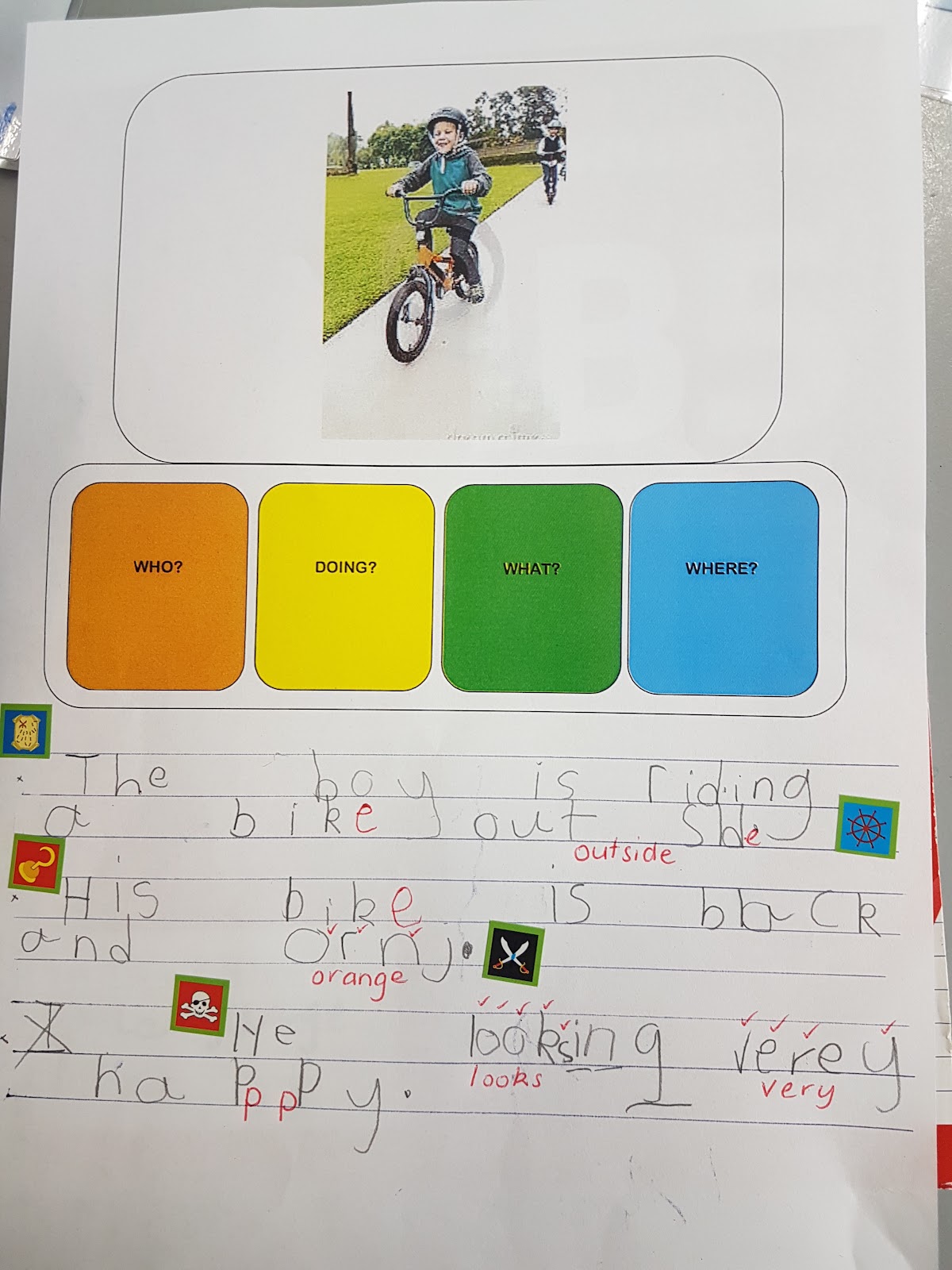
This student was able to add more details to his writing. He said 'I like this writing".
He will recites the 'Who , doing, what ' out loud as he writes.


This student is using nouns and verbs, but is still missing the little words.
The sentence is then modeled to her by the teacher and she is able to copy.
She was more motivated and wrote her sentence immediately.


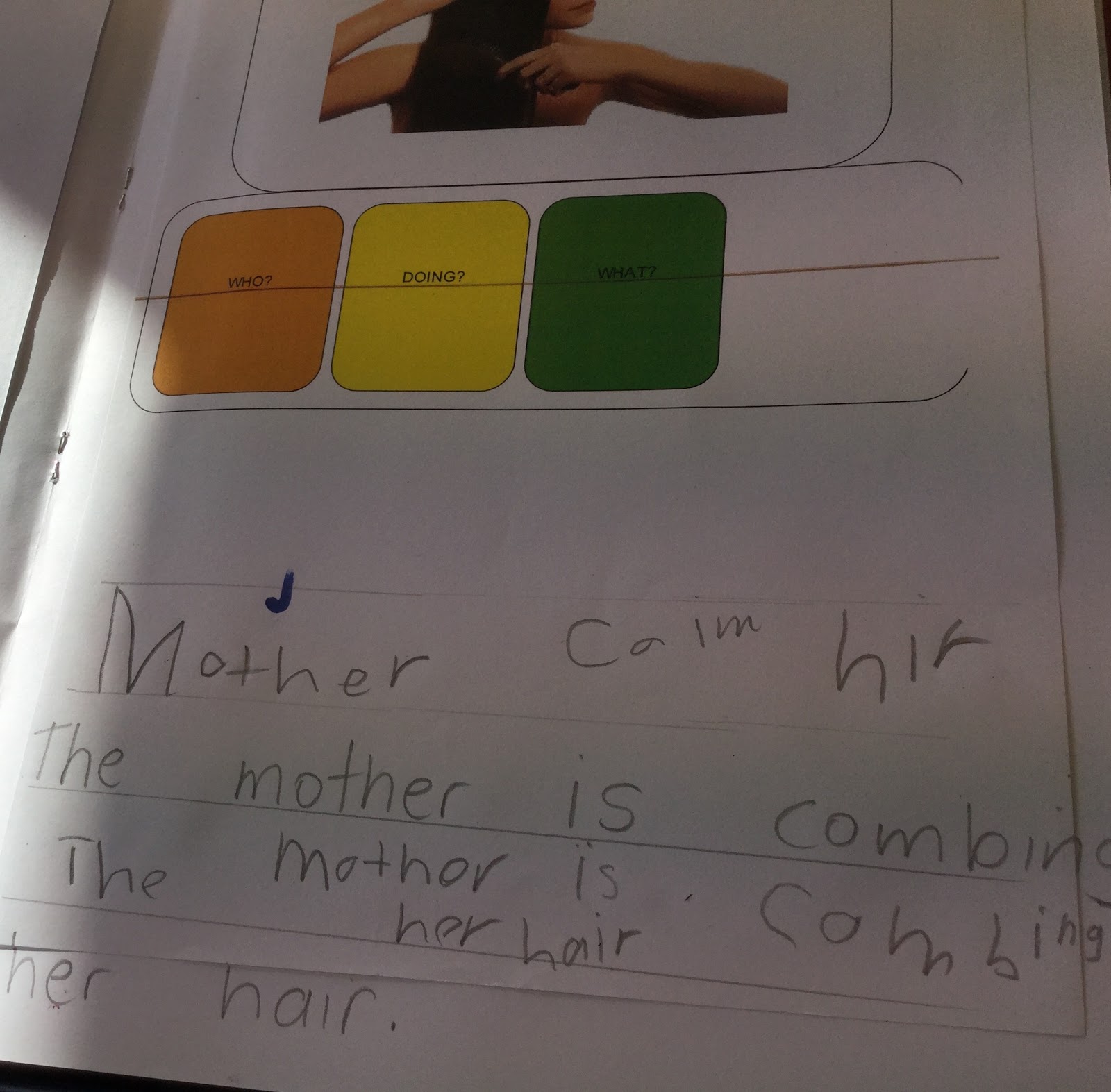
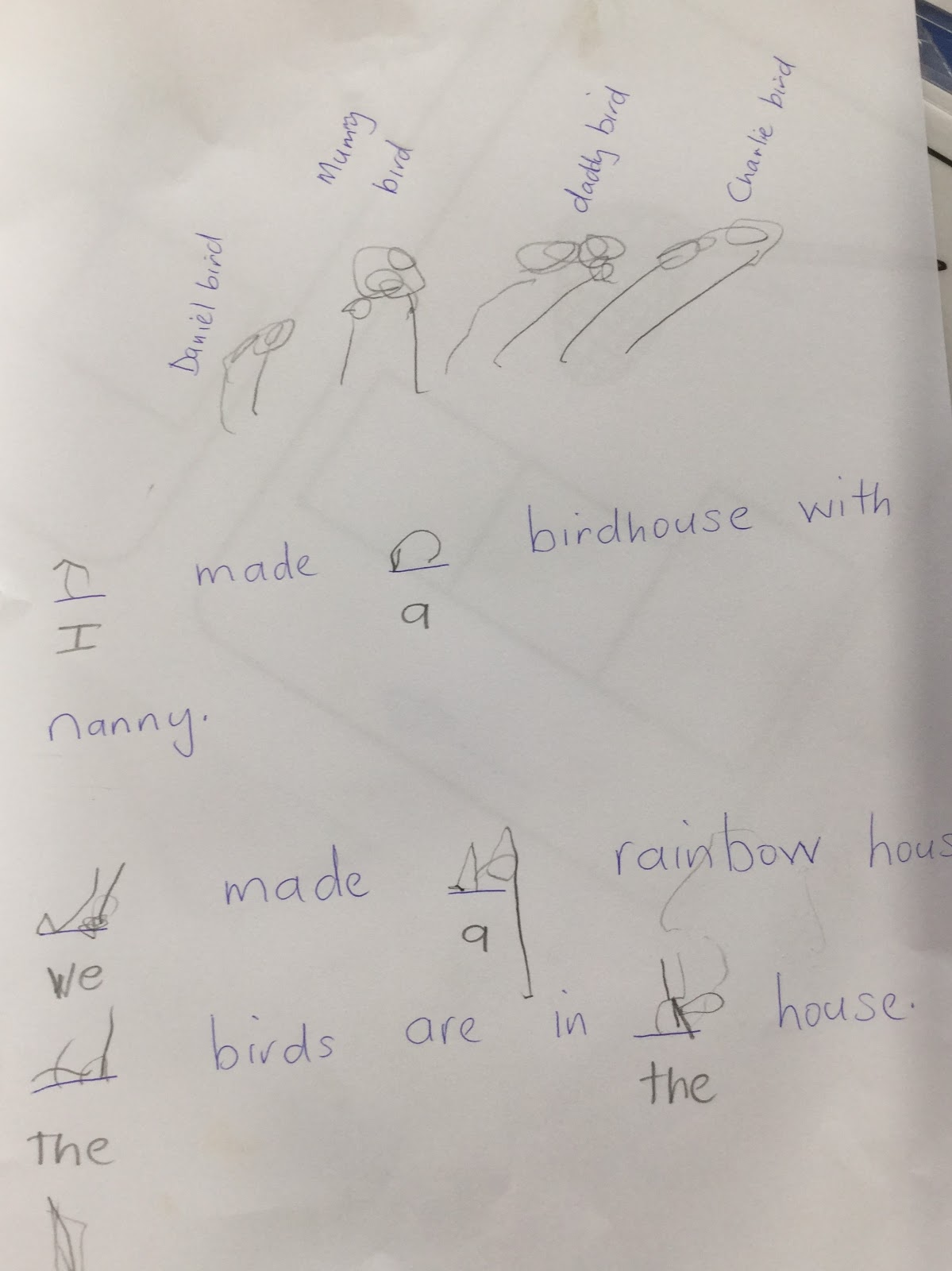
This example is of a student who is only beginning to write.
He knows what he wants to say and tells his sentence to the teacher, he attempts the ‘THE’.
There is no pressure for him to write, we are looking for ideas. He enjoys having the Pictures as visual
supports and he is also following, ‘who, doing what.’

Tuesday, 11 June 2019

Questions we can ask about writing

As teachers , here are some questions we can ask about the way we teach writing.

Writing is a complex task, involving ideas, language, words, spelling and transcribing or selecting letters. We need to teach all of these skills – and eventually students need to be able to do all of these, within the one task, to become writers.

Overall guidelines
  • Do you have time scheduled for an independent writing block every day?
  • Are your students using a pencil or alternative writing tool that allows them to focus on the cognitive aspects of writing e.g. alphabet board, flip chart, keyboard, eye gaze system, iPad and app, computer, pen or pencil?
  • Does their writing tool include access to all 26 letters of the alphabet?
  • Do your students have real reasons for writing? (and remember – writing never involves copying and tracing; writing involves thinking of ideas, language, words AND transcribing)
  • Do you model writing to your classroom each time before you ask them to write?
  • Do you have a time for writer’s chair so that students can share their writing with others?
  • For emergent students
  • Are you giving your students lot of opportunities to learn the function of writing without focusing on the form e.g. following through on notes handed to you, writing yourself reminders and then using them, writing a morning message?
  • Do they have daily opportunities to write without standards using a writing tool with access to all 26 letters?
  • When they have finished writing do you say “now let me show you how I would write it” and model writing rather than interrupting them during the writing task or putting demands on their writing?
  • Are you offering them a range of writing tasks, such as writing about personal experiences, high interest topics, classroom topics, letter writing, signing in?
  • Are you following through on writing tasks e.g. posting letters?
  • Do you have a daily or weekly shared writing activity, such as predictable chart writing?

Writing (with an alphabet chart, teacher scribes)


💚Student signing in→


For conventional students

  • Do you focus your modelling of writing on different aspects of the writing task each day e.g. using the word wall, using capitals, using punctuation, thinking of ideas, thinking of your audience in planning writing, using different sorts of vocabulary, etc.?
  • Are you modelling aspects of writing for a while before you expect your students to start using them?
  • Are you including free writing so that students learn to self-select in this block?
  • Have you done a chart of topics “we all know about” with your class as ideas for free writing?
  • Are you using the prompt “tell me more about that” to get students to extend their writing?
  • Are you teaching students to edit writing, starting with teaching them to edit your writing and then transitioning to their own?
  • Are you using editing checklists as students start self-editing e.g. “do my sentences have capitals and punctuation, do all my sentences relate to the topic”?
  • Are you encouraging your students to publish?

Monday, 3 June 2019

Colourful Semantics


What is Colourful Semantics?


Hypotheses - 3  

If I use the Colourful Semantics program to motivate students, will this then help them to form a sentence independently.

My students struggled to understand the parts of a sentence. I began teaching what WHO, DOING WHAT , WHERE means using The Colourful Semantics programme. We worked on many examples.
I began to use this program when one of my emergent students was really struggling to construct a simple sentence. He wasn’t able to recall events from the weekend, had no idea of subject and verb. This program uses visual supports which helped the student. I spent a few weeks teaching what WHO, DOING WHAT MEANS. 

Colourful semantics is an approach created by Alison Bryan. It is aimed at helping children to develop their grammar but it is rooted in the meaning of words (semantics).
Colourful semantics reassembles sentences by cutting them up into their thematic roles and then colour codes them.
The approach has 4 key colour coded stages. There are further stages for adverbs, adjectives, conjunctions and negatives.
1.     WHO – Orange
2.     WHAT DOING – Yellow
3.     WHAT – Green
4.     WHERE – Blue
The approach helps children to organise their sentences into key levels. The approach is used in stages and helps children develop language and vocabulary in addition to grammatical structure. It can be used to help children who are starting to develop language and have limited vocabulary to confident talkers who struggle to organise the grammatical content of their sentences.
Who can use Colourful Semantics?
The approach can be used with children with a range of Speech, Language and Communication Needs including:
·       Specific Language Impairment
·       Developmental Delay or Disorder
·       Autistic Spectrum Condition
·       Down Syndrome
·       Literacy difficulties
Why use Colourful Semantics?
There are a range of benefits to using this approach, including but not limited to;
·       Encouraging wider vocabulary
·       Making sentences longer
·       Helps children to answer questions or generate responses to questions
·       Developing use of nouns, verbs, prepositions and adjectives
·       Improves story telling skills
·       Can be transferred to written sentences and written language comprehension
·       Can be carried out individually or in small groups


After explicitly teaching my student to use this program, the next few examples are of students at different levels

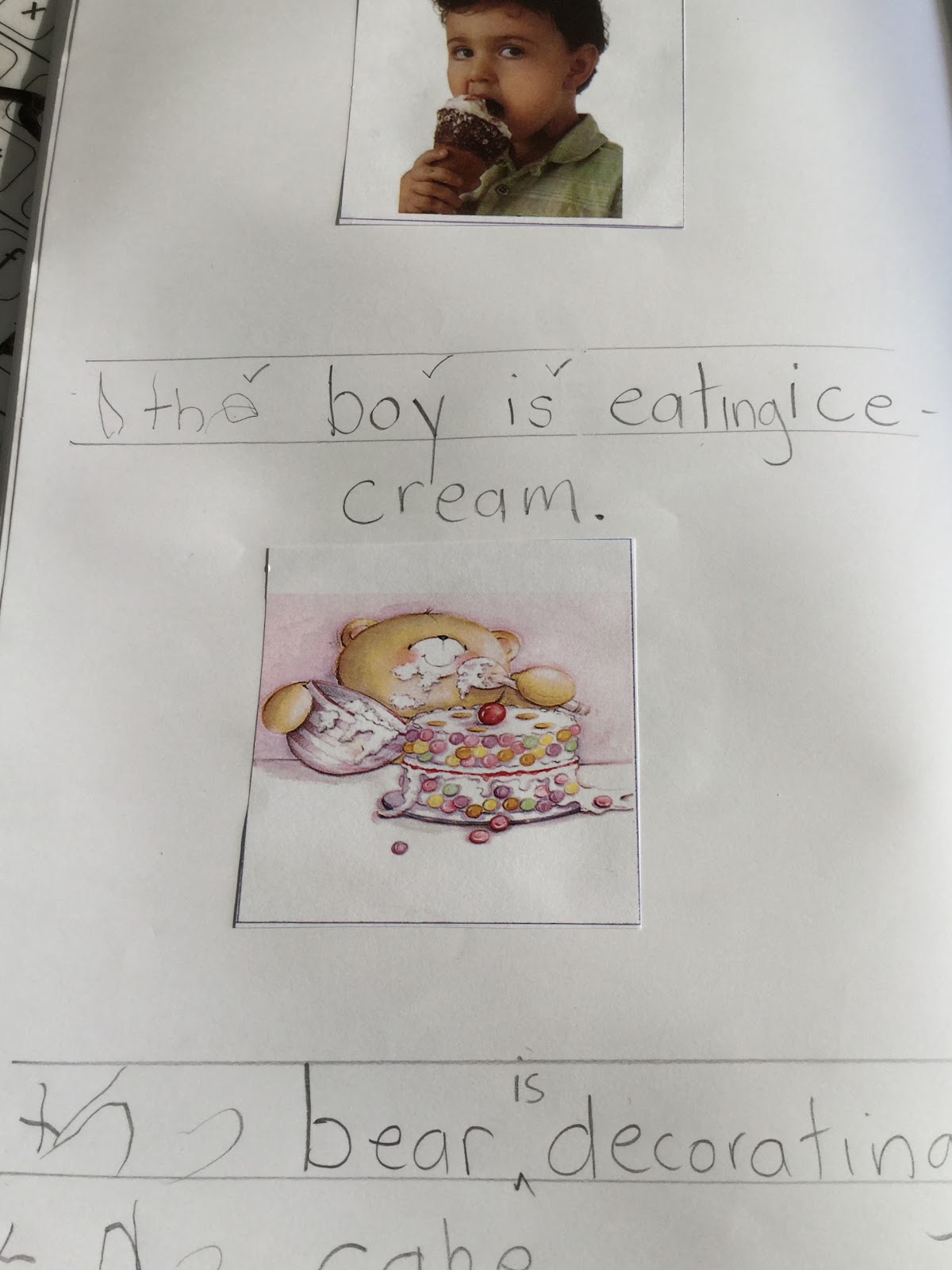
This is one of my student's work sample using Colourful semantics, just with visuals


In this example, the student isn't writing independently, so  I wrote what the student said and modeled what needed to be done. 


This student is writing with support. Using colorful semantics to help her construct her sentence,this is what she wrote. 

All three examples show students using Colourful Semantics, but at their individual level.
Will this work for my other students?

Tuesday, 28 May 2019

Investigation of handwriting vs device

Hypothesis 2-Handwriting VS device


I will look at if I simply use a device as a motivator to do writing, then will this be enough for my students to form a simple sentence, or would other skills need to be taught.

This is a writing sample of one of my Yr 8 students who has language delays and is not motivated write. I wanted to see how she constructs a simple sentence using pictures as prompts.
This is what she wrote.


She said I hate writing, I want to use the computer. She was given the same activity and she was allowed to use the computer. This is her independent writing. 


Over the next few weeks, we worked on punctuation and verbs.  We also worked on forming simple sentences, understanding the parts to a sentence. I assumed she knew this, but it had to be taught. We also used an editing checklist. She was encouraged to spell check. 


This was her writing sample thereafter.


There needed to be explicit teaching of these skills in order for her to succeed. She was very excited to see no red lines and that her writing "looked right".


Monday, 20 May 2019

Writing for real reasons

Why do we need to write for real reasons

When students know why they need to write, they will be more motivated to write.
My students are not motivated to write, they need to know why they must write, the purpose of writing and how is it going to help them.
These  are some examples that can help.


Friday, 17 May 2019

Emergent writers

Supporting Emergent Writing 

Hypothesis 1- writing for real reasons
If I encourage my students to write for real reasons, then will they be motivated to write.

In Sally Clendon's research, she says that:
Students who write become better readers, writers, and thinkers.Students learn in classroom writing communities where they have the opportunity to:
– write for real reasons 
– see others write
– interact with peers and teacher about the written content, use, and form. 
– write without standards (i.e., without pressure to write neatly, spell correctly, and follow rules like capitalization, punctuation).

I will share some work that I am doing with one of my students who is working at level one. Due to his intellectual and physical complexities, he requires lots of motivation to engage in writing. My biggest focus at the moment is for my student is to know why he needs to write ie, writing for "Real Reasons"

Writing for real reasons- Level 1


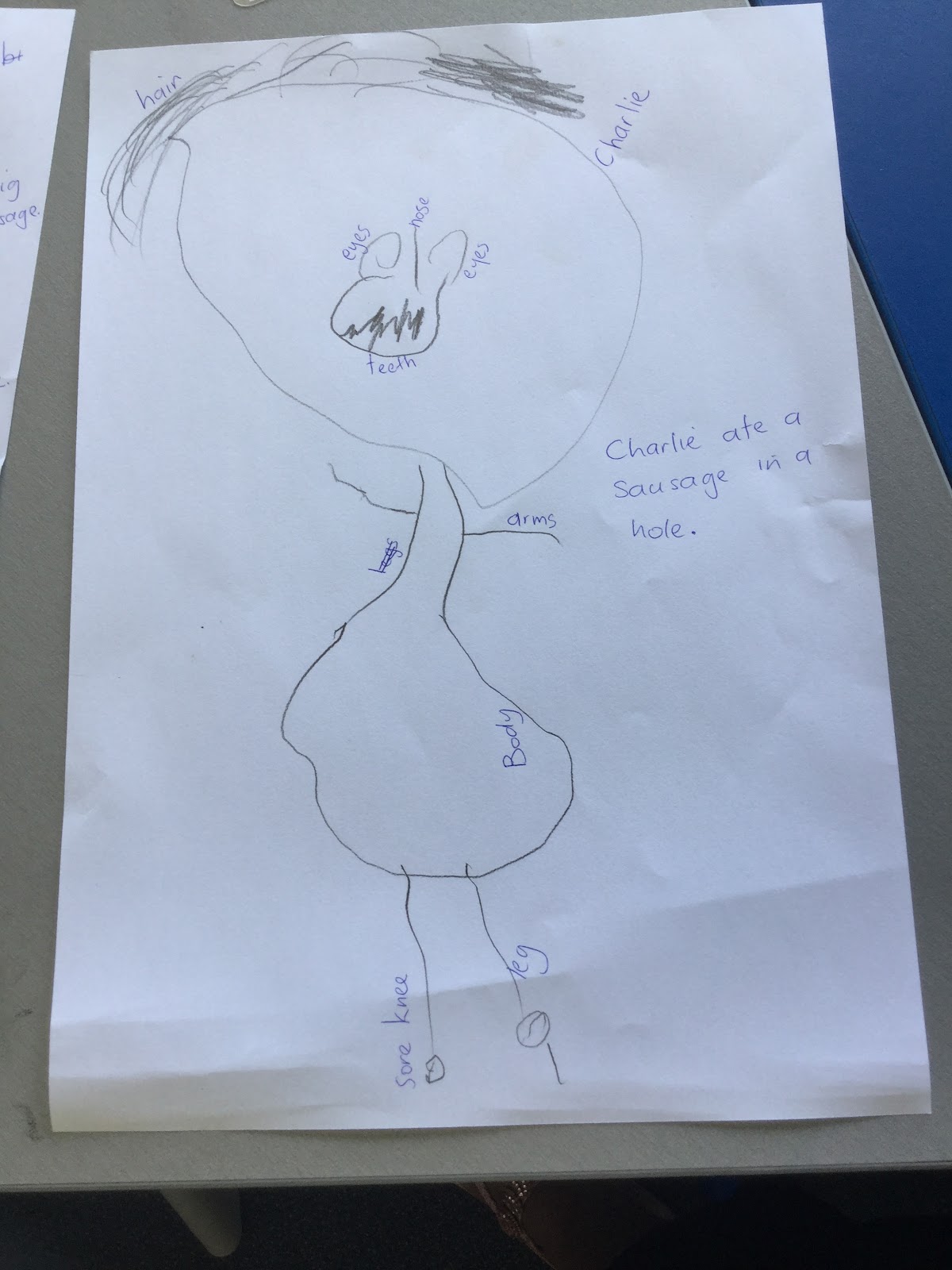
Student drew and shared his experience,
teacher recorded what was said.
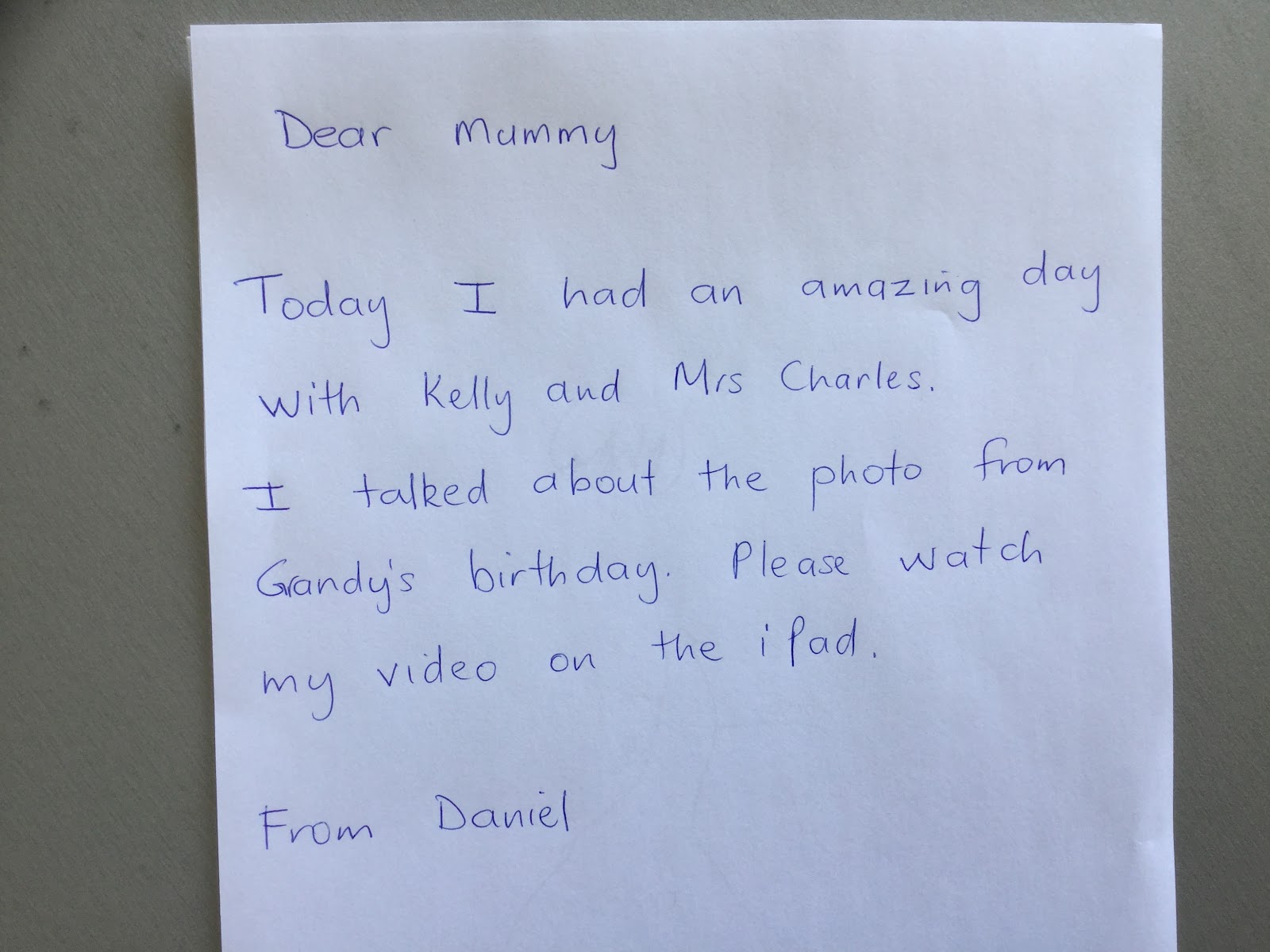
Teacher wrote a letter to family
so the student can see a real reason for writing.
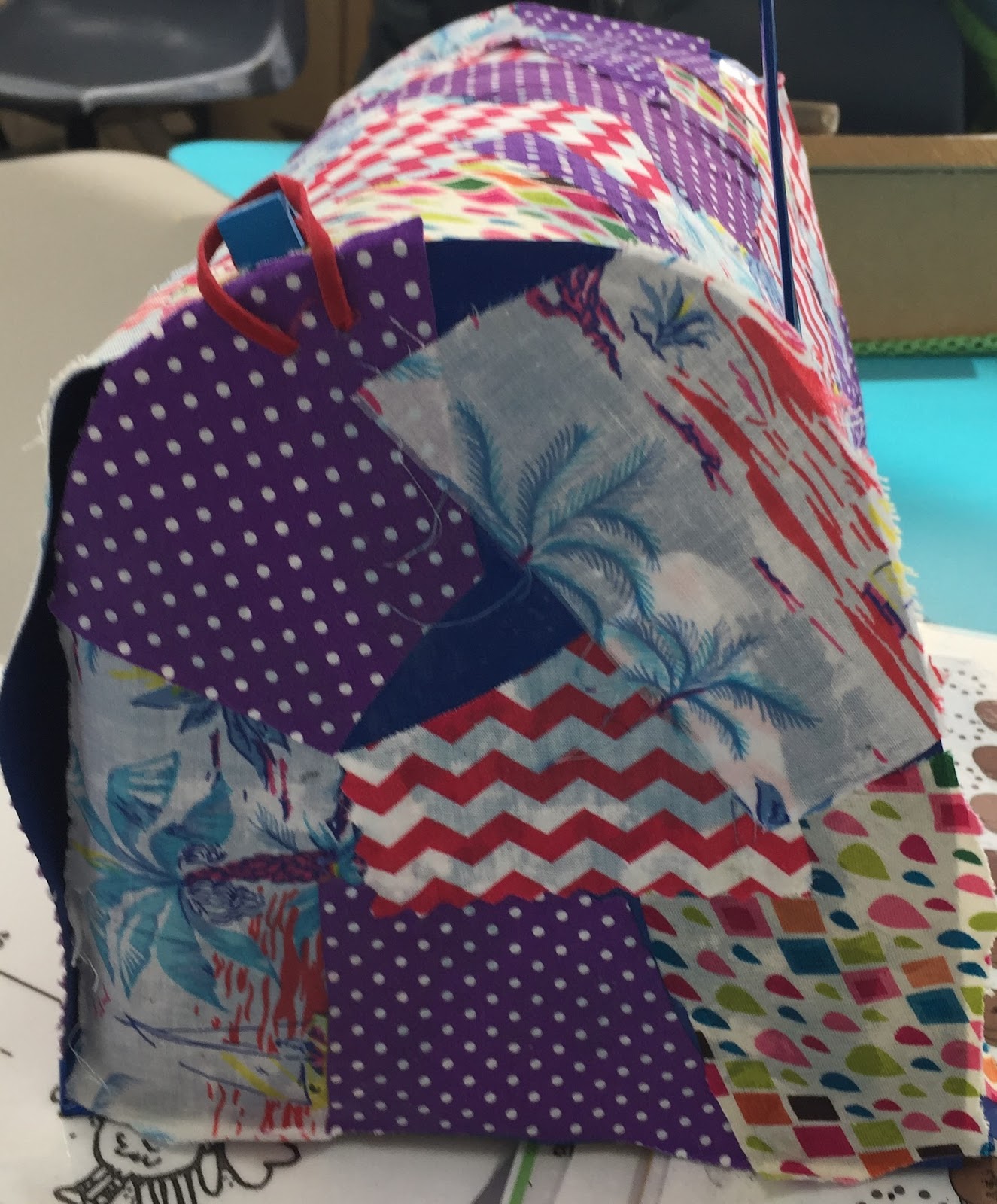
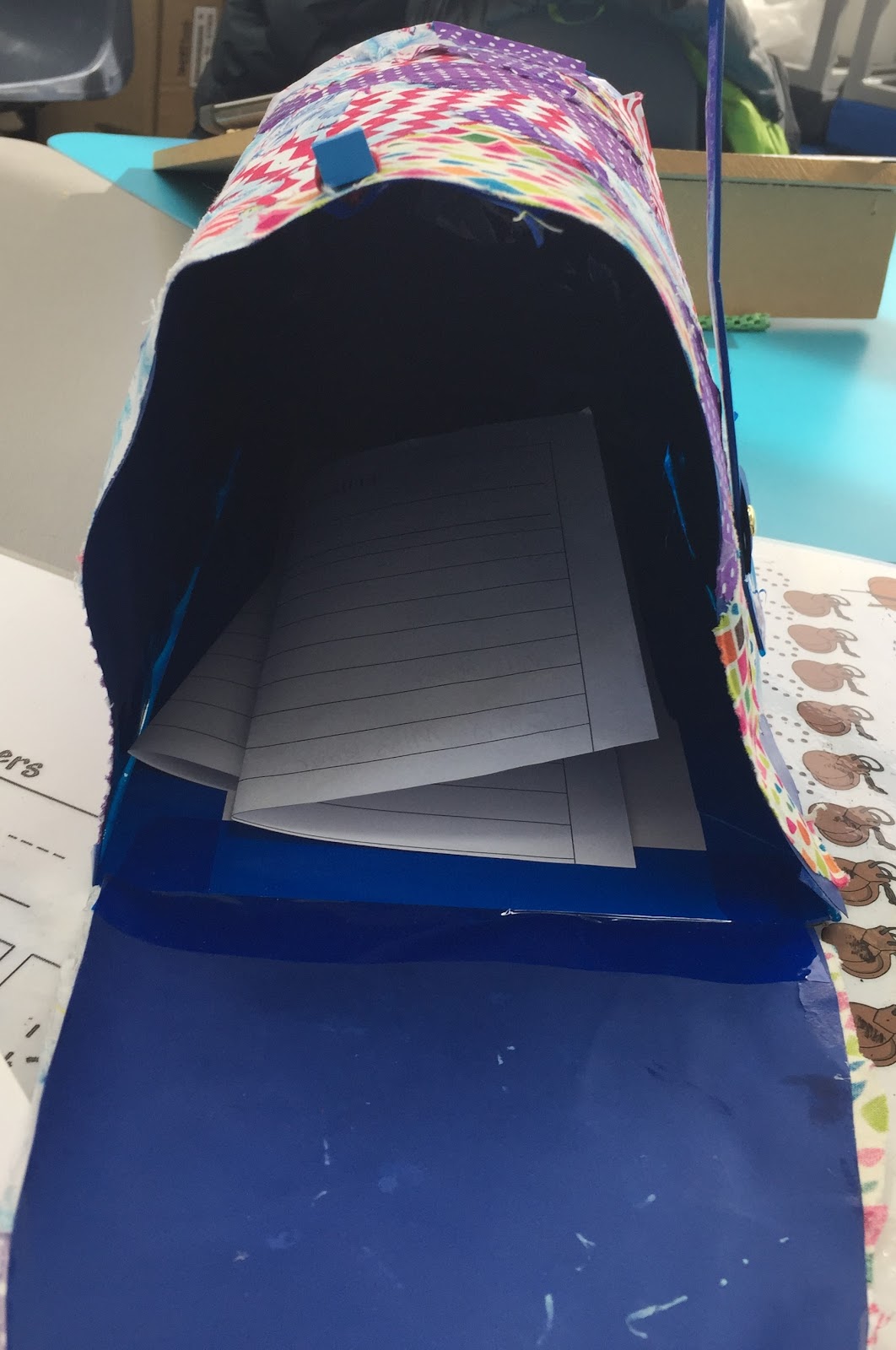
Family made a postbox to sent
and receive letters
Students at school also send letters
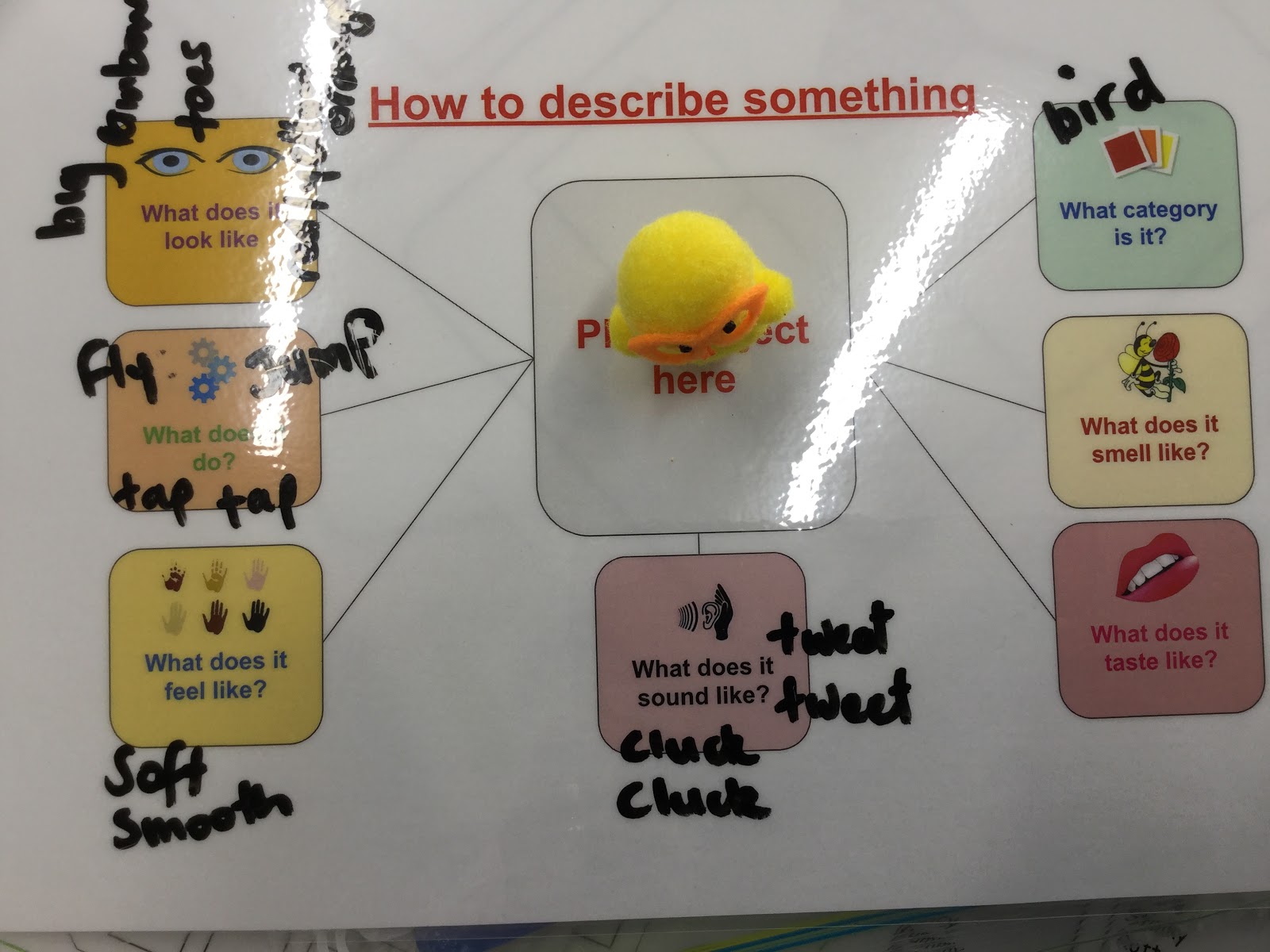
Student is asked to describe the object
using his senses.
Prompts that can be used


Student tells the story, teacher writes,
leaving opportunities for student to attempt writing.
Student attempting independent writing

This student was definitely  motivated, but will my other students be motivated to write for real reasons?

Tuesday, 7 May 2019

Developmental writing scale


Developmental writing scale for assessment 


In my previous post I discussed using the development writing scale. This is what Jane Farrall says:
I hope this will help you work out the level that your student might be on.

Using the Developmental Writing Scale for Writing Assessment

by Jane Farrall

The Developmental Writing Scale (Sturm et al 2012) is a key part of this. This scale is so useful as it allows us to track a student's writing progress from emergent to conventional with a 14 point scale.  Most importantly it also has accommodations listed for students who use alternative pencils - which is important for most of the students I work with.
The Developmental Writing Scale
As I said earlier, the Developmental Writing Scale is a 14 point scale that goes from emergent to conventional and then through the early stages on conventional writing - in the Australian Curriculum the highest level on the scale is at a grade 4 and 5 writing level. We use the level descriptors to decide what level each piece of writing is at - and then those level descriptors help us to work out what skills we need to teach them to move to the next level.
And now, to demonstrate how this process works, let's look at each level on the scale along with examples.

Level 1 

Drawing - lines and curves that appear to represent objects.  Accommodations: Selection of a picture by a [student] who cannot hold a traditional pencil or marker.

If we go back to my blog post called Emergent Writing: Focus on Function, this is how we would rate Mathilda's first "writing sample" - which I have also put below.  This is the stage at which an individual doesn't recognise the difference between writing and pictures - and this is the point at which we (the adults) do lots and lots of attributing meaning and assuming competence to teach them them that they are a writer.  Then we continue to use those same two adult superpowers to teach them that print has meaning and that everything they say they can write.  Frequent writing practice with adults attributing meaning and assuming competence is how individuals move to the next point on the scale.

Level 1 Sample, Drawing

Level 1 Sample, generated with a flip chart - student selected the picture when we did the extra task as explained below
The accommodations part of this scale is REALLY important for any student using a keyboard or flip chart.  A sample collected with these alternative pencils, and which is scored at level 1, needs to be accompanied by an extra task with the student.  Basically, we provide the student with some writing and a picture.  The easiest way to do this is to use a children's picture book.  I prefer to use one which has writing on one side and a picture on the other.  I then ask them to "show me the writing". If they select the picture, then they are rated as a level 1.   The reason for this task being so important will become apparent as we get to level 3 on the scale.

Level 2

Scribbling - Continuous vertical, circular or wavy lines arranged linearly across the page, which may include letter-like forms, but with the majority of shapes not recognizable as letters. Accommodations: if an [individual] uses a keyboard [or flip chart], this level would not be used.

For individuals with good fine motor skills, this is where they start to demonstrate that they have had enough experiences with text to know that there is a difference between print and picture - and then this starts to show up in their writing.  Below is a perfect example of this stage.  This is an old sample that my friend Dianne sent me - a letter from her nephew to his grandmother.

Level 2 Sample Handwriting
Again, the accommodation part of the scale for level 2 is really important - and this is basically that if the student is using an alternative pencil, then we don't see level 2 in their writing development - they jump straight from level 1 to level 3.

Level 3

Letter Strings (no groups) - Handwritten or typed strings of letter but not grouped into words. Accommodations: alphabet display (e.g. paper copy) and standard or electronic keyboard access (e.g. on screen keyboard or AAC system)

For a student holding a pen or a pencil, this is where they show us that they've learned enough about text to know that it is composed of letters - and so we start to see those letters in their writing.  For students who are using a keyboard or a flip chart, we've already been seeing letter strings because their alternative pencil is setup for them to write with letters.  BUT remember the accommodation from level 1.  If we do that separate "show me the writing" task with them and they select the picture, then we would rate their sample as level 1.  If they show us the writing, then we rate their sample as a level 3.   And the accommodation from this level is a lot easier - it's just suggested alternative pencils that writers can use.  Just remember no matter what level you are at you need to have access to all the letters of the alphabet.

Level 3 Sample, generated with an alternative pencil (keyboard in Proloquo2Go)

Level 3 Sample, handwriting

Level 4

Letter Strings Grouped in Words - Strings of letters grouped into "words" (ie with spaces between at least two groups of letters) but with no intelligible words. Accommodations: Alphabet display (eg paper copy) and standard or electronic keyboard access (e.g. on screen keyboard or AAC system)

This is the level where a developing writer shows us that they have learned one more thing about writing - which is that they know that as well as letters there are also spaces. It should look very similar no matter what pencil is being used!

Level 4 Sample, generated with a flip chart (full stop added by adult who was transcribing the letters).

Level 5

Strings of letters grouped into "words" with only one possible real word (ie two or more letters in length) set apart, written repeatedly or embedded in a string of letters. Accommodations: Word bank or word prediction software.

And now developing writers have paid enough attention to text, that they incorporate one real word into their own writing. The real word has to be two or more letters - so you can't count "I" or "a" . Sometimes we find that the one real word is a high frequency word, and sometimes it's a high interest word. Oh - and you might also see spaces disappear again at this point.

Level 5 Sample, typed on a computer

Level 5 Sample, generated using the keyboard in Proloquo2Go (I have blanked out the student's name)

Level 6

Two or three different intelligible words - Two or three different intelligible words embedded in strings, separated by spaces, or in a list format. Single letter words such as "I" and "a" must be separated by spaces to count as an intelligible word. Accommodations: Word bank or word prediction software.

At this level, most writers are now spelling words phonetically. We also get some writers who meet all the criteria for this level who spell their two or three words perfectly as they develop more and more sight words. For a sample to be rated Level 6 there are also a couple of rules about spaces. The first Level 6 space rule is that spaces don't have to be there! The main example within the scale is : IYTKTOSMNTHETR (I like to swim under water). There isn't a single space - and that's fine. The second rule of spaces is that if you want to count I or a you need it to be separated by a space from any surrounding words - otherwise it's too easy to do them by chance.
Level 6 Sample, handwriting. "Jax is bin monitor"

cat eat fla.

Level 6 Sample. typing. "cat eat fly"

Level 7

Three or more different intelligible words in a list - Three or more related words. Accommodations: Word bank or word prediction software.

This is often one of the easiest levels to identify. There are usually a lot of nouns in the sample and there are no "little words". The two rules about spaces from Level 6 are also still in force.

Level 7 Sample, generated using the keyboard in Proloquo2Go "water, swimming, goggles, evie"

Level 8

Partial sentence of more than three words - More than three different intelligible words, with at least two of them in a partially formed sentence (ie gramatically related parts of a phrase, clause or sentence). Accommodations: Word bank or word prediction software.

The description says it all! It's also worth knowing that spaces are still optional at this stage.

Philip and Jayden playing you no

Level 8 Sample, typing "Philip and Jayden playing Uno"

Atthpiooltogoswimmig shaun taz

Level 8 Sample, typing "At the pool to go swimming shaun taz"

Level 9

One to two complete sentences - Sentences have a subject phrase and a verb phrase. End punctuation is not necessary. Accommodations: Word bank or word prediction software.

Follow the level description - and remember spelling doesn't have to perfect, it just needs to be at a level where the intended audience can read the piece of writing. This is also the first level where spaces are needed between words - and they need to be used for the future levels too.
Level 9 Sample. typed on the keyboard in Proloquo2Go and inserted into the message window

Level 10

Three or more unrelated sentences (neither coherent nor cohesive) - Sentences have no coherent topic (ie sentences are not related). Accommodations: Word bank or word prediction software.

For this level, we want to see end punctuation. We also need to remember that spelling still doesn't have to be perfect - just at a level where the intended audience can read it. And this rule also applies to the last four levels. Always remember that we teach spelling and words in the working with words block - not within writing.
Level 10 Sample, written on iPad (app used not recorded) "I am reading a book I like reading. I have a watch. I have a bike."

Level 11

Three or more related sentences (coherent but limited cohesive) - Organized writing with three or more sentences on a coherent topic but with limited cohesion between sentences (ie sentences can be reordered without changing meaning). Accommodations: Word bank or word prediction software.


Level 11 Sample, handwriting

Level 12

Three or more related sentences that cannot be reordered (coherent and cohesive) - Organised writing with a coherent topic (ie on a consistent theme) and use of cohesive devices (eg pronoun or synonym replacement, logical connectors, subordinating conjunctions, conclusions that refer to prior content) across three or more sentences so that sentences cannot be reordered without meaning. Accommodations: Word bank or word prediction software.

On Thursday 2nd or August I went to the basketball carnval at Pdsadena high school. on the Photo I am sitting with my mate. I am happy. We one six games and lost one game. I scored somes three ponters. I would love too join a basketball team.
Level 12 Sample, typing

Level 13

Two coherent paragraphs of at least three cohesive sentences each - organised writing with a coherent main topic and two cohesive subsections (subtopics or story parts) with at least two sentences elaborating the meaning of each. Accommodations: Word bank or word prediction software.

Level 13 Sample, typing

Level 14

Three or more coherent paragraphs of at least three cohesive sentences each - organised writing with a coherent main topic and at least three cohesive subsections (subtopics or story parts), with at least [three] sentences elaborating the meaning of each. Accommodations: Word bank or word prediction software.

My long weekend
On Friday, I watched the two spare garbage trucks. One was doing the garbage, the other was doing the recycling. They were both white ones. They met together on my street. The recycling came before the garbage. It was good. I also went out with mum and dad for a drive. I saw a few buses which were 769, 791, 773, 776, 755, 1755, 1471, 1210, 2456, 2554, 2515, and 1810. It was a good day.
On Saturday I went shopping with mum and got stuff from coles before Showdown 45. The power lost to the crows. The power should have won.
On Sunday I went for a drive with mum and dad. We drove past Pasadena High School where I went for the Basketball carnival. It was a good drive.
I had a great weekend.
Level 14 Sample, typing

And that's the whole scale! Hopefully those explanations and examples have helped you in your students' writing.